.svg)
.svg)

CFD Flow Simulation: Practice for Mechanical Engineering & Automotive
CFD flow simulation in mechanical engineering and automotive, with realistic analysis of flow, cooling, aerodynamics, and combustion chamber. Increase efficiency, reduce costs.

CFD Flow Simulation: Practice for Mechanical Engineering and Automotive
CFD flow simulation has long been more than a virtual experiment. It is a central development tool with which flow and thermal processes are realistically represented. Engineers identify critical flow areas, temperature peaks, or unfavorable pressure profiles already in the concept phase without producing physical prototypes. This saves time, reduces testing costs, and enables targeted design improvements.
In mechanical engineering, CFD supports the design of pumps, valves, heat exchangers, or cooling concepts for power electronics. In automotive technology, it provides reliable insights into aerodynamics, battery thermal management, engine charging, or combustion chamber flows. The decisive advantage is the ability to compare different design variants under identical boundary conditions and thus make data-driven development decisions.
Fundamentals of CFD Technology
Computational Fluid Dynamics (CFD) is based on the numerical solution of the Navier-Stokes equations, which mathematically describe the behavior of fluids. These complex partial differential equations are discretized and iteratively solved on a three-dimensional computational grid using numerical methods such as the finite volume method.
The typical CFD workflow is divided into three main phases: In preprocessing, engineers create the geometry, generate the computational grid, and define boundary conditions. The actual simulation solves the equations either as a steady-state or transient process. In the final postprocessing, results are visualized and analyzed.
Modern CFD software enables the simulation of complex phenomena such as turbulent flows, multiphase flows, or coupled heat and mass transfer. This versatility makes CFD an indispensable tool for product development.
Application Areas in Mechanical Engineering
In mechanical engineering, CFD supports the development and design of flow-relevant components and processes. Typical applications include pumps, valves, pipelines, fans, agitators, and heat exchangers. Flow fields, pressure losses, and temperature distributions can be analyzed virtually without producing physical prototypes. Even in agricultural machinery, CFD provides insights for reducing dust generation and aerodynamic improvement of attachments and blowers.
A central area is the cooling of electrical and electronic components. With CFD, hotspots, uneven air guidance, or local heat accumulation can be identified early. This allows cooling channels, fan positions, or coolant routing to be specifically optimized. This increases thermal stability and extends the service life of critical components.
In process engineering, CFD models drying processes, combustion chambers, fluidized bed systems, or chemical reactors. Flow distribution, residence time, mixing, temperature fields, and mass transport can be precisely represented. This allows plants to be designed more efficiently and processes to be operated economically stable.
CFD provides particularly valuable information for valve optimization. Pressure loss, cavitation, flow separations, or noise generation become visible and quantifiable. This enables engineers to develop valves with higher flow rates, improved operating behavior, and longer service life.
CFD in the Automotive Sector
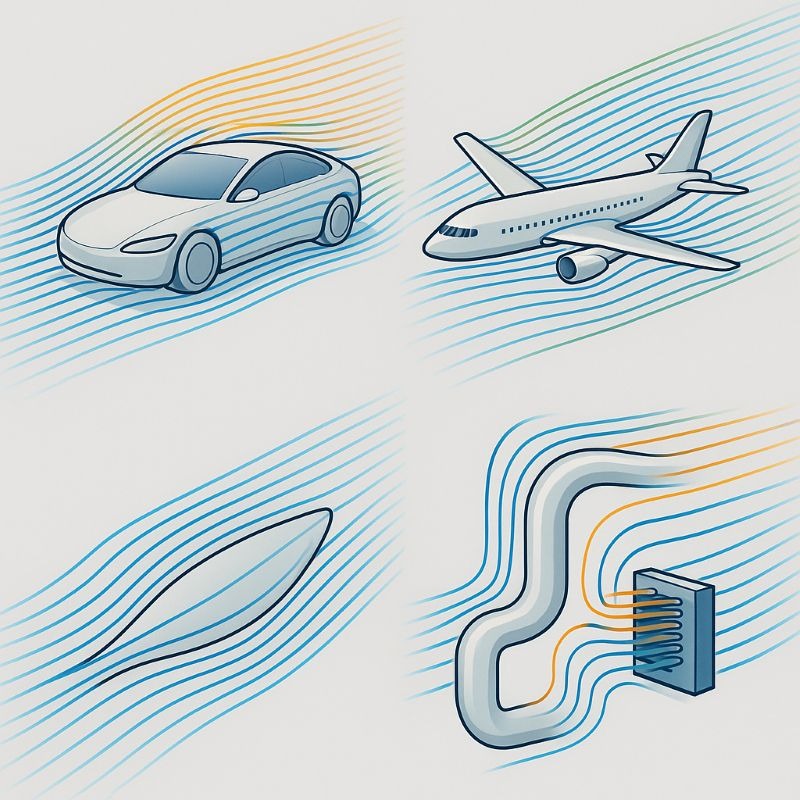
CFD is an integral part of modern development processes in vehicle development. A central application area is aerodynamics. Virtual analyses allow air resistance, lift, and side forces to be quantified and specifically reduced. This improves fuel consumption, range for electric vehicles, and driving stability. CFD also enables the investigation of air flows on bodywork, spoilers, underbody, or cooling air intakes, as well as the identification of flow-induced noise sources.
Another core area is thermal management. CFD supports the design of cooling air routing, heat exchangers, fan arrangements, and battery cooling structures. In electric vehicles, uniform temperature distribution and avoidance of local overheating are crucial for battery performance, aging, and safety. The interaction of cooling circuits and ambient air can also be virtually evaluated.
In engine development, CFD provides detailed insights into flow in the combustion chamber. Flow structures such as tumble, swirl, or squish influence mixture formation, ignition, and emissions. Through simulation of injection process, wall wetting, exhaust gas recirculation, and combustion reaction, design and control can be specifically optimized.
HVAC systems can also be efficiently designed with CFD. The analysis of air flow, temperature distribution, and air velocities in the vehicle interior improves comfort, defrosting, and energy efficiency. This allows climate and ventilation systems to be realistically evaluated and optimized early.
Flow Simulation CFD: Methodological Approaches
The choice of the appropriate CFD method depends on flow characteristics, accuracy requirements, and computational effort. Basically, a distinction is made between steady-state and transient simulations. Steady-state approaches consider settled states with constant boundary conditions. Transient simulations capture time-dependent behavior, for example periodic separations, pulsations, or rotating machines. Both RANS and LES can be used in steady-state or transient mode, depending on the physical phenomenon.
RANS models, Reynolds Averaged Navier Stokes, statistically average turbulent fluctuations and are most widely used in industrial applications. They are suitable for the design of cooling channels, valves, aerodynamics, or pressure loss calculations. RANS can be used in steady-state mode for stable flows or transient when time-dependent processes such as rotating components, cyclic loads, or flow separations are to be considered.
LES, Large Eddy Simulation, explicitly represents large turbulent structures and models only small eddies. This enables significantly higher resolution in the analysis of flow separations, vortex structures, mixing processes, or acoustic effects. LES is always calculated transiently, as turbulence is a dynamic process. The computational effort is higher than for RANS, but LES offers more physical detail.
For multiphase flows, specialized methods such as Volume of Fluid, Euler Lagrange, or Level Set are used. They model phenomena such as fuel injection, droplet behavior, coolant distribution, or foam formation.
Coupled simulations consider the interaction of flow with heat conduction, structural mechanics, or chemical reaction. Such multiphysics approaches are indispensable for heat exchangers, battery modules, combustion chambers, or fluid-structure loads on components.
CFD Programming: Software and Tools
In industrial applications, established CFD software solutions with graphical user interface and validated physical models dominate. Commercial tools such as ANSYS Fluent, STAR-CCM+, COMSOL Multiphysics, or Siemens FloEFD offer robust solvers, integrated meshing tools, and extensive model libraries for turbulence, heat transfer, multiphase flows, or chemical processes. They are particularly suitable for engineering departments with requirements for reproducible results, support, and interfaces to CAD and PLM systems.
OpenFOAM is the leading open-source solution and is preferably used where individual model adaptations, script control, or high-level automation are required. It offers maximum flexibility but requires solid CFD knowledge as well as experience in numerical modeling and Linux-based workflow structure.
Cloud platforms such as SimScale or Ansys Cloud enable access to scalable computing power without own HPC infrastructure. They are suitable for pilot studies, short-term simulation projects, or companies with low investment budgets for hardware and licenses.
With scripting and API control, CFD processes can be automated. Python or macro-based workflows enable meshing variants, optimization loops, parameter variations, and integration into existing engineering systems. This makes CFD increasingly part of digital development processes and enables efficient design exploration.
Quality Assurance and Validation
Quality assurance and validation are central components of every CFD analysis, as simulations are not an end in themselves but support technical decisions. An essential step is the mesh convergence study. Here, the computational grid is gradually refined to check whether flow quantities such as pressure loss, temperature, or turbulence parameters stabilize. Only when the results are independent of the mesh resolution is the numerical solution considered reliable.
Experimental validation remains the most important reference point. Measurements in wind tunnels, test stands, or experimental facilities serve as comparison values. If simulation and measurement differ, this indicates inadequate model assumptions, incorrect boundary conditions, or numerical inaccuracies. At this point, model choice and simulation setup must be reviewed.
Physical plausibility checks form another quality criterion. Conservation of mass, momentum, and energy must be fulfilled. In addition, flow structures, turbulence distributions, or temperature fields should be logically comprehensible. Dimensional analysis and order-of-magnitude estimates support the evaluation.
Uncertainty quantification evaluates the sensitivity of simulation results to assumptions and input data. Variations in material data, boundary conditions, or turbulence parameters are systematically varied, for example through Monte Carlo approaches. This allows the robustness of the prediction to be better assessed and documented.
Optimization Strategies with CFD
CFD is increasingly used not only for analysis but for active improvement of technical systems. With CFD-based optimization, geometries, operating parameters, or flow concepts can be automatically adapted to defined target values. Various methodological approaches are used, depending on problem structure, number of variables, and computational effort.
Gradient-free methods such as genetic algorithms, particle swarm optimization, or simulated annealing are suitable for complex and nonlinear design spaces. However, they require many function evaluations and are therefore computationally intensive. The advantage is robust search without assumptions about the structure of the solution space.
Adjoint methods offer high efficiency for optimization problems with many design variables. They calculate sensitivities of the target value directly from a CFD simulation and thus enable targeted shape or topology optimization. They are particularly suitable for aerodynamic components, flow channels, or heat exchangers.
Response surface methods combine CFD simulations with statistical or data-driven surrogate models. Machine learning approaches such as neural networks or Gaussian process regression create surrogate models with which optimizations can be performed significantly faster without having to fully simulate each variant.
Multi-objective optimization considers competing requirements such as efficiency, pressure loss, costs, weight, or noise generation. Pareto analyses allow optimal compromises to be identified and development margins to be made visible early.
AI-Assisted CFD Development
Artificial intelligence increasingly complements classical CFD methods in early development phases as well as in design exploration and automated comparative studies. The goal is not to replace CFD solvers but to make them more efficiently usable through data-based models, automated variant analyses, and faster predictions.
Machine learning-based surrogate models are currently the most important application. Based on CFD simulations or measurement data, ML models are trained that can estimate flow or temperature fields with significantly reduced computing time. They are particularly suitable for parameter variations, cooling concepts, HVAC design, battery thermal management, or simplified flow routing in duct and pipe systems.
Reduced-order models, sometimes combined with machine learning, are used as digital twins, for example in thermal management systems or in condition monitoring of battery modules. They do not deliver full CFD quality but stable and fast predictions for operating behavior.
Convolutional neural networks are increasingly used to automatically evaluate results from simulations. They recognize patterns such as flow separations, vortex zones, or hotspots and support engineers in interpretation and model validation.
Generative models and reinforcement learning are currently mainly the subject of research projects. They offer potential benefits, such as automatic geometry generation or active flow control, but are only sporadically in trial use in industrial practice.
The real added value of AI in CFD currently lies not in fully automated development but in accelerated variant analysis, support in optimization runs, and intelligent post-processing of simulation results.
Industrial Implementation and Best Practices
For reliable use of CFD in product development, technical competence and structured work processes are equally important. A key success factor is the establishment of standardized workflows that cover both geometry preparation as well as meshing, solver configuration, and result evaluation. Such process guidelines ensure reproducible results and reduce effort for recurring tasks or variant studies.
Project-specific modeling guidelines define which physical models, boundary conditions, and simplifications are appropriate. Not every question requires high detail or transient simulations. For many development decisions, steady-state RANS models with suitable mesh quality already provide reliable statements. A clear classification of model types by application helps to balance computing time and accuracy sensibly.
Decisive is the collaboration of different departments. CFD specialists, designers, test engineers, and thermal management experts jointly evaluate geometry variants, boundary conditions, and validation results. Regular technical reviews improve model quality and prevent misinterpretations.
Professional data management ensures that setups, mesh configurations, material data, model assumptions, and results are documented in a traceable manner. Version control, structured result archiving, and automated reporting processes enable both internal quality assurance and later reuse of models in further development phases or digital twin applications.
Economic Advantages of CFD Application
CFD brings not only technical but also measurable economic advantages. In typical development projects, two to four months of project duration can be saved through the use of virtual flow analyses, and up to six months for complex thermal or aerodynamic tasks. The reason for this is the significantly reduced need for physical prototypes and test loops. Instead of three to five prototypes, often only one function-validating test carrier is needed.
Prototype costs in mechanical engineering often range between €5,000 and €50,000 per piece, depending on component size and complexity. In the automotive sector, especially for thermal components, aerodynamic parts, or battery modules, prototypes with measurement setup can cost well over €100,000. CFD makes it possible to evaluate several development variants purely virtually and thus completely save one to two prototype generations.
Early identification of critical areas such as hotspots, unfavorable flow patterns, or pressure loss avoids expensive rework in late development phases. Design changes after the first physical prototype often cost three to five times more compared to adjustments on a simulation basis in the concept phase.
Optimized products bring additional economic benefits. Improved cooling performance, lower energy consumption, or reduced noise generation increase efficiency and market value. In series products, this can lead to savings in the double-digit percentage range in material consumption or energy demand.
CFD thus provides a reliable basis for design decisions and significantly reduces development risks. Especially for new developments and further developments with high requirements, the use begins to pay off from a project volume of approximately €30,000; for larger development programs, CFD is indispensable today.
Conclusion
CFD flow simulation is today a strategic development tool and no longer an optional add-on. Both mechanical engineering and automotive industries use it to evaluate thermal, aerodynamic, and flow engineering tasks early and reliably. Design, testing, and simulation increasingly interlock.
The continuous improvement of solver technologies, meshing tools, and hardware enables higher accuracy with shorter computing times. Cloud systems and flexible licensing models lower the entry barriers, so that even smaller companies can use CFD economically. Artificial intelligence additionally accelerates variant analyses, result interpretation, and design optimization, but remains complementary to physical simulation.
Decisive for success is not the software alone, but the combination of physical understanding, clean modeling, methodical execution, and consistent validation. Only this structured approach enables simulations with technical benefit and economic relevance. Those who specifically integrate CFD into development processes reduce risks, shorten project durations, and sustainably increase product quality.
Contact Felsaris for professional CFD solutions that accelerate your development processes and optimize your products. Use our expertise for practice-oriented flow simulations with measurable results.
Frequently Asked Questions About CFD Flow Simulation
What Does a CFD Simulation Cost?
The costs of a CFD simulation depend on the task, modeling effort, and desired evaluation depth. Small steady-state individual analyses realistically start at about €4,000 to €6,000 if geometry, boundary conditions, and target values are clearly defined. More complex 3D simulations with transient behavior, thermal coupling, or variant comparison are usually between €8,000 and €20,000. For extensive projects, such as overall vehicle aerodynamics, battery thermal management, or multiphysics investigations, costs can be significantly higher. Cloud-based billing and on-demand models enable flexible project design without permanent license investment. For time-limited CFD needs, our CFD on-demand solutions may be interesting for you: CAE Engineering
How Long Does a Typical CFD Analysis Take?
For clearly defined, steady-state individual analyses with good model preparation, results are realistic within one week. More extensive, transparently calculated cases with mesh optimization, validation, and evaluation require 2-6 weeks. For series investigations, thermal coupling, or multiphysics simulations, processing can take several months. Parallelization, cloud computing, and automated workflows significantly reduce computing times.
What Accuracy Does CFD Offer Compared to Experiments?
For established applications with validated boundary conditions and suitable model approach, the deviation is typically 3-10% compared to test stand or wind tunnel. Accuracy depends strongly on mesh quality, turbulence model, boundary conditions, and physics modeling. For safety-critical or strictly regulated applications, experimental validation is still required.
Can CFD Completely Replace Physical Prototypes?
CFD significantly reduces the need for physical prototypes but does not completely replace them. Simulation-supported development enables the selection of fewer, specifically optimized prototypes. For final validation, certification, or manufacturing tests, real experiments remain indispensable. In many projects, the number of physical prototypes can be reduced by around fifty to seventy percent.
Which Software Is Best Suited for CFD Beginners?
For beginners, tools with graphical interface and solid documentation are sensible, for example STAR-CCM+, ANSYS Fluent, or CONVERGE. They offer integrated meshing, guided workflows, and technical support. Cloud platforms such as SimScale enable first access without own hardware. OpenFOAM is powerful, flexible, and free but requires significantly more CFD and scripting experience.