.svg)
.svg)

E-Fuels in Motorsport: Engineering and Technical Limits
E-fuels in motorsport: what synthetic fuels are, why they matter for racing engines, and the technical limits on injection, combustion and validation.

E-Fuels in Motorsport: Use, Engineering and Limits of Synthetic Fuels
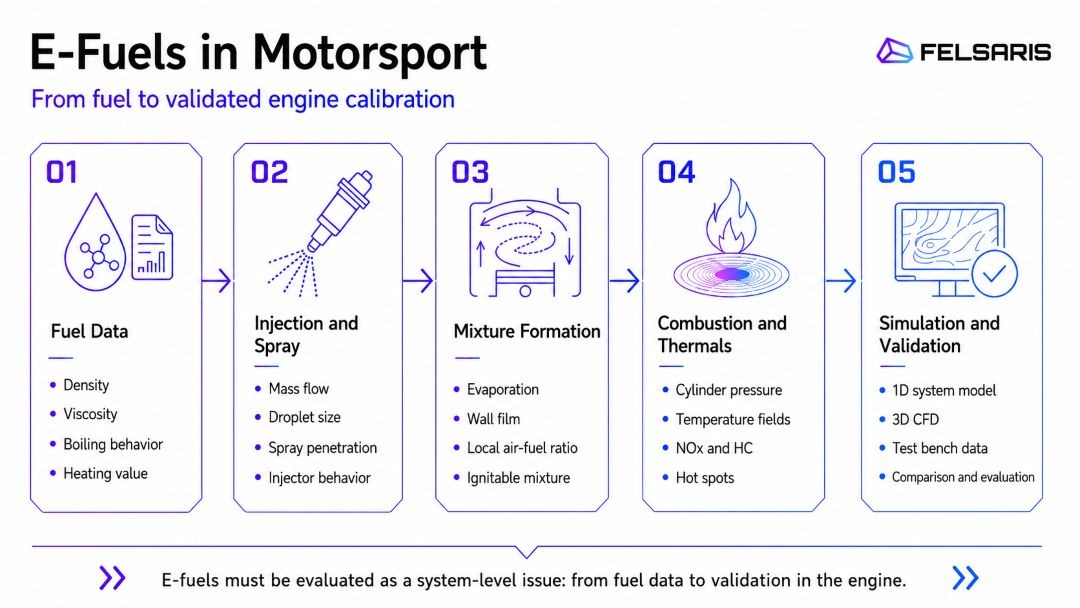
E-fuels in motorsport are often discussed as a way of continuing to develop the internal combustion engine under changing sustainability requirements. For racing series, engine developers and suppliers, however, the origin of the fuel is only one part of the question. What matters technically is how a synthetic fuel behaves in a specific engine: during injection, evaporation, mixture formation, ignition, combustion, emissions formation, thermal loading and validation.
This article provides a technical overview. It explains what e-fuels are, why they are of interest in motorsport and why synthetic fuels are not a simple drop-in issue. The focus is deliberately not on a broad sustainability narrative, but on the engineering questions that arise when new fuels are used in high-performance environments.
What are e-fuels in motorsport?
E-fuels are synthetically produced fuels. In the narrow definition, they are produced from hydrogen and CO₂, with the hydrogen ideally generated using renewable electricity. The carbon is not sourced from fossil extraction, but introduced into the fuel cycle from a defined CO₂ source.
This distinction matters in motorsport. Not every sustainable racing fuel is automatically an e-fuel. Racing series may also use biogenic, waste-based or blended fuels. Technical and regulatory statements should therefore always make clear whether they refer to synthetic e-fuels, biogenic fuels or the broader category of sustainable racing fuels.
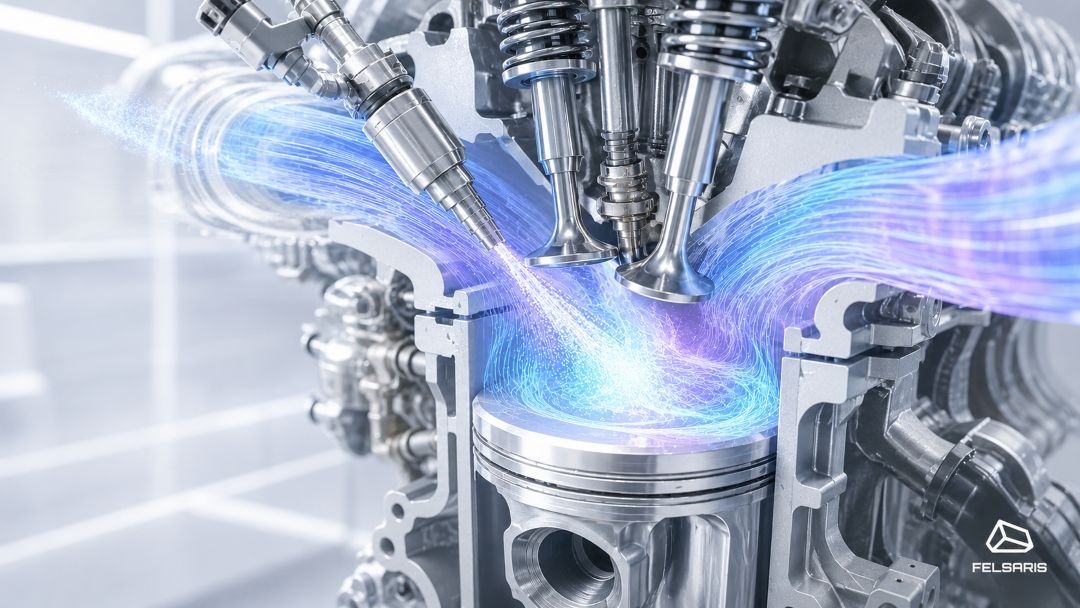
From an engineering perspective, e-fuels should not be described only by how they are produced. Engine development depends on specific fuel properties. These include density, viscosity, vapour pressure, boiling behaviour, surface tension, heating value and heat capacity. These properties influence how the fuel flows through the injection system, how the spray breaks up, how quickly the droplets evaporate and whether wall film forms in the combustion chamber.
An e-fuel is therefore more than a sustainability label. It is a fuel with specific behaviour inside the engine.
Why are e-fuels relevant for motorsport?
Motorsport places particular demands on powertrains. Racing engines operate under high loads, rapid load changes, high temperatures and tight regulatory limits. At the same time, refuelling time, energy density, packaging, weight, existing test bench infrastructure and engine expertise all play a major role.
Liquid fuels remain relevant in this environment because they combine high energy density with short refuelling times. For racing series that want to continue using internal combustion engines, e-fuels or other sustainable racing fuels can therefore be a relevant building block. They allow existing engine architectures to be developed further under new boundary conditions rather than being abandoned entirely.
That does not mean that changing fuel is trivial. New fuels can affect calibration, combustion, emissions behaviour, material contact and thermal loading. A racing engine that operates reliably on fossil petrol is not automatically approved for every synthetic fuel.
The technical value of e-fuels therefore lies not only in their possible contribution to the CO₂ balance. Motorsport can also serve as a demanding development environment in which fuel, engine, injection system, thermal behaviour and validation can be assessed under realistic high-load conditions.
Where are sustainable fuels used in motorsport?
Sustainable fuels are becoming relevant in various motorsport environments. They are particularly visible where regulations, series positioning and technical development are closely linked.
Formula 1: fuel as part of the overall system
Formula 1 is a prominent example because new fuel requirements are not considered in isolation. In the FIA Technical Regulations 2026, fuel is regulated as part of a complex technical system. This includes requirements for fuel composition, fuel properties, approval processes and integration into the power unit architecture.
For technical assessment, a single regulation value is less important than the overall system logic. The fuel interacts with the internal combustion engine, hybridisation, energy flow, air path, cooling, packaging and operating strategy. Sustainable fuels in high-performance motorsport are therefore not simply a procurement topic. They are part of powertrain development.
Endurance racing: fuel behaviour under continuous load
Endurance racing is technically interesting for sustainable fuels because it does not only reflect peak power. Over many hours of racing, thermal stability, fuel consumption, repeatability, refuelling strategy, material behaviour and durability all become critical.
In endurance applications, a fuel must do more than work at a single operating point. It has to be assessed across a load spectrum: high load, part load, transients, temperature windows, exhaust behaviour and endurance running. This combination is what makes endurance racing relevant for the technical assessment of alternative fuels.
Production-based racing formats: closer to vehicle engineering
Production-based racing formats are also relevant for e-fuels and sustainable fuels. They combine motorsport load profiles with vehicle architectures that are closer to real platforms than purely prototype-based race cars. This creates different development questions than in top-level racing series.
Technical assessment is not only about maximum power. Calibratability, material contact, durability, fuel system behaviour, emissions behaviour and transferability to related applications are also decisive. Proximity to production vehicles does not replace approval for road use, but it can provide valuable indications of technical challenges.
Why e-fuels are not a purely drop-in issue
The term drop-in is often used in connection with e-fuels. It usually means that a fuel may in principle be usable in existing infrastructure or existing engines. For technical development, however, this term is too broad.
Changing fuel affects more than the chemical origin of the fuel. It can influence injection, evaporation, wall film, ignition, emissions formation, material contact and thermal loading. The key question is therefore not whether an e-fuel is broadly similar to petrol. The key question is how the specific fuel behaves in the specific engine and load profile.
For liquid fuels, several effects are relevant:
A global lambda value is not sufficient for this type of assessment. It describes the average air-fuel ratio, but not the local mixture distribution in the combustion chamber. Especially in high-performance engines, local effects can be decisive: overly rich regions, incomplete evaporation, wall wetting, temperature peaks or unstable ignition.
E-fuels can be interesting for existing engine architectures. Whether they can be used with limited adaptations depends on fuel data, injection system, engine architecture, calibration, material compatibility and validation.
Which technical requirements arise in a racing engine?
A racing engine does not evaluate fuels under ideal conditions. It operates with high mass flows, high temperatures, rapid transients and tight trade-offs between power, fuel consumption, thermal durability and emissions.
For e-fuels, the following assessment parameters are particularly relevant:
These variables are interdependent. A fuel with favourable evaporation behaviour may provide different benefits from a fuel with high knock resistance. A changed enthalpy of vaporisation can cool the charge, but can also affect mixture formation and wall wetting. An engine may run stably on average while local regions in the combustion chamber remain problematic.
For development, this means that e-fuels should be treated as a system question from an early stage. Fuel data, injection, combustion chamber geometry, boosting, cooling and test bench strategy belong together.
What role does simulation play for e-fuels in motorsport?
Simulation can help engineers understand the effects of a fuel change earlier. It does not replace the test bench. A staged model chain consisting of system simulation, 3D CFD and validation is particularly useful.
1D system simulation is well suited to system-level relationships. This includes the air path, boosting, gas exchange, engine map, operating strategy, cooling and transients. 3D CFD becomes important when local causes have to be assessed: intake port flow, spray, wall film, mixture formation, in-cylinder flow, heat transfer and temperature distribution.
For development questions close to Felsaris' work, this combination is particularly relevant. A fuel change rarely creates only a single local question or only a system-level question. Operating states and boundary conditions from the overall system often have to be understood before local 3D effects can be assessed meaningfully.
For example, if an e-fuel shows different evaporation behaviour, it is not enough to consider only the combustion chamber in isolation. Injection timing, wall temperature, pressure level, air path, boosting and load point all influence the result. 3D CFD can make local mechanisms visible. Test bench data determine whether the model is robust enough for the technical question.
Felsaris supports these types of engineering questions through simulation-based development, technical system assessment and validation logic.
Where are the limits of e-fuels in motorsport?
E-fuels can be a relevant building block for lower-carbon motorsport concepts. They do not automatically solve all technical, economic or ecological questions.
CO₂ balance and system boundaries
Carbon-containing e-fuels still produce CO₂ at the exhaust. The difference lies in where the carbon comes from and how the fuel was produced. A statement such as CO₂-neutral is therefore only meaningful if the system boundary is clearly defined.
At minimum, the following levels should be distinguished:
- Tank-to-Wheel: vehicle emissions
- Well-to-Tank: production and supply of the fuel
- Well-to-Wheel: the entire chain from energy source to vehicle operation
- Life-cycle assessment: additional system elements such as infrastructure, transport and plants
Without this system boundary, the term climate-neutral remains too imprecise. A more cautious formulation is preferable: e-fuels can contribute to reducing fossil carbon if they are produced appropriately and assessed within a clearly defined accounting boundary.
Regulations change
Motorsport regulations are time-dependent. Fuel definitions, hybrid requirements, permitted components, measurement procedures and sustainability criteria can change. Technical statements about racing series, fuel types or performance values should therefore always be checked against the currently applicable regulations.
For development projects, this is a practical issue. A fuel can be chemically interesting and still unsuitable for a specific series if the regulations, approval process or component requirements do not fit.
Drop-in is not an approval label
Even if a fuel is described as close to drop-in, this does not replace technical assessment. For the specific engine, material compatibility, calibration, emissions, endurance testing, thermal loading and safety questions remain relevant.
A robust engineering text should therefore not claim that e-fuels work without adaptation. A safer formulation is: depending on the fuel and engine architecture, e-fuels may be usable with limited adaptations, but they must be validated on a project-specific basis.
Which companies are technically affected by e-fuels?
E-fuels are not only relevant for racing series. They become relevant wherever existing internal combustion engine platforms are to be further developed, reassessed or operated under changed fuel and sustainability requirements.
Typical target groups include:
- Motorsport teams
- Low-volume vehicle manufacturers
- Engine developers
- Test bench operators
- Component developers for injection, air path, boosting and cooling
- Companies with existing internal combustion engine platforms
- Suppliers with a focus on materials, fuel systems or calibration
These companies face specific technical questions:
- Which fuel is intended for the target operation?
- Which material property data are available?
- Is a calibration change sufficient or does the hardware need to be modified?
- Which emissions and temperature targets apply?
- Which components are in contact with the fuel?
- Which data are needed for simulation and test bench work?
- Which regulatory limits apply in the target series?
- Which system boundary applies to sustainability claims?
Felsaris combines relevant technical methods within its core competencies. These include simulation-based analysis, technical assessment and the combination of modelling, system understanding and validation.
E-fuels and hydrogen: related topics, but different development questions
E-fuels and hydrogen are often mentioned together in the context of sustainable powertrains. Technically, however, they are different development fields.
E-fuels are carbon-containing or synthetic fuels that can operate within existing liquid fuel paths. Hydrogen in an internal combustion engine shifts the development question much more strongly towards gas jet behaviour, injection strategy, backfire risks, NOx, lean operation and safety concept.
This distinction is important because the two topics create different simulation and validation questions. Anyone assessing hydrogen as a fuel for internal combustion engines has to consider different risks than with liquid e-fuels. Felsaris treats these questions separately in the field of hydrogen engine development.
Conclusion: e-fuels are a technical development field, not a simple fuel swap
E-fuels in motorsport connect several topics: sustainability requirements, existing internal combustion engine expertise, high power density, regulatory limits and demanding load profiles. That is exactly why they are technically interesting. At the same time, they should not be presented as a simple solution.
A synthetic fuel has to work in the specific engine. Injection, evaporation, wall film, mixture formation, ignition, combustion, emissions, material contact, thermal behaviour and validation all matter. Anyone wanting to assess e-fuels in motorsport from an engineering perspective must therefore discuss not only the origin of the fuel, but also its behaviour within the powertrain system.
If you want to assess a specific development project involving new fuels, changed load profiles or simulation-based validation, Felsaris can support the technical evaluation.
Frequently asked questions about e-fuels in motorsport
What are e-fuels in motorsport?
E-fuels are synthetically produced fuels that, in the narrow definition, are produced from hydrogen and CO₂. They are of interest in motorsport because they can combine liquid fuels with existing internal combustion engine technology. From a technical perspective, however, the decisive factor is not only how they are produced, but how they behave in the engine. This includes injection, evaporation, mixture formation, combustion, emissions and validation.
Are e-fuels in motorsport CO₂-neutral?
E-fuels should not be described generically as CO₂-neutral. Carbon-containing fuels still produce CO₂ at the exhaust. Whether their use is CO₂-reduced on an accounting basis or potentially CO₂-neutral depends on the electricity source, hydrogen production, CO₂ source, synthesis process, transport and system boundary. It should therefore always be made clear whether the assessment refers to Tank-to-Wheel, Well-to-Wheel or a life-cycle assessment.
Can e-fuels be used in existing racing engines?
In principle, e-fuels can be relevant for existing engine architectures. Whether a specific racing engine can be operated reliably with them depends on fuel data, injection system, material compatibility, combustion concept, calibration, emissions and validation. The term drop-in is not sufficient for this. Technical approval must be carried out on a project-specific basis.
Why is CFD important for e-fuels?
CFD can make local processes visible that are difficult to detect using global parameters. These include spray behaviour, droplet evaporation, wall film, mixture distribution, temperature fields, heat transfer and local emissions formation. The value of a CFD simulation depends on boundary conditions, mesh quality, model selection and validation. CFD supports technical decisions, but does not replace real-world validation.
What is the difference between e-fuels and sustainable racing fuels?
E-fuels are synthetic fuels produced from hydrogen and CO₂. Sustainable racing fuels is a broader term and may also include biogenic, waste-based or blended fuel components. For technical and regulatory statements, it must therefore be clear which type of fuel is meant. Otherwise, origin, CO₂ balance and engine behaviour are mixed together imprecisely.
Why are e-fuels not a simple drop-in solution?
Changing fuel affects more than chemical composition. E-fuels can influence injection, evaporation, wall film, ignition, combustion, emissions, material contact and thermal behaviour. The specific fuel must therefore be assessed in the specific engine and load profile. In motorsport in particular, high loads, rapid transients and narrow temperature windows are relevant.