


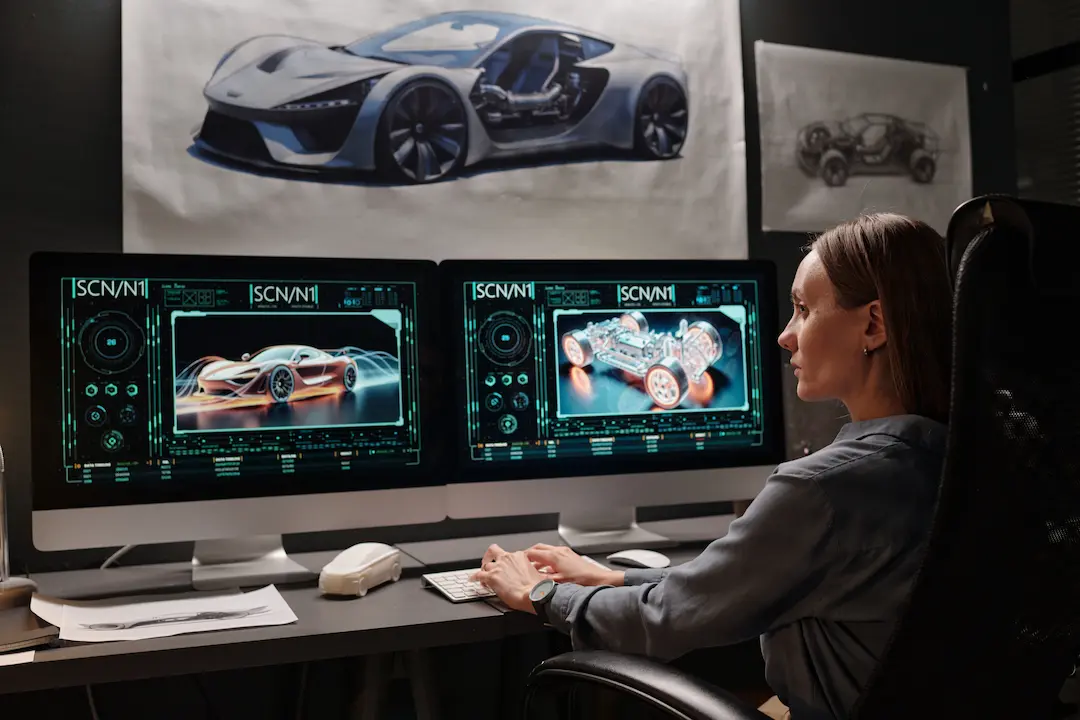
Automotive Industry in Transition: Technology Leadership Through Innovation
The automotive industry is undergoing one of the most profound transformations in its history in 2026. While electric powertrains dominate the market, AI-driven development processes, digital simulation technologies, and alternative fuels such as hydrogen are simultaneously shaping the future of mobility. This technological revolution requires manufacturers and suppliers to develop entirely new capabilities in product development at Felsaris.
The German automotive market is facing mixed signals. While forecasts for 2026 expect moderate growth of 5 percent, industry experts warn of a decline in new registrations to around 2.5 million vehicles. At the same time, the global market for software-defined vehicles is reaching a volume of 287.64 billion US dollars. These figures show that the automotive industry is not only electrifying, but also undergoing a fundamental digital transformation.

Electromobility as the Driving Force of the Transformation
Electromobility has evolved from a niche segment into the market standard. Battery electric vehicles (BEVs) are expected to account for 25 percent of new registrations in 2026. This development forces automakers to make fundamental changes to their production lines and development processes.
The VW Group is launching a true product offensive with small electric cars such as the Cupra Raval, VW ID. Polo, and Skoda Epiq, which are expected to achieve a range of around 450 kilometers. Premium manufacturers such as BMW and Mercedes are bringing completely new models to market that are based on dedicated electric platforms and promise ranges of more than 800 kilometers.
This development presents engineers with new challenges. Battery management, thermal optimization of electrical systems, and the integration of complex software architectures require specialized simulation methods and precise development tools. CFD analyses for cooling electric motors and batteries are becoming just as important as aerodynamic optimization for maximum range.
AI-Driven Product Development Is Revolutionizing Engineering Processes
Artificial intelligence is fundamentally changing how vehicles are developed. Modern development processes use machine learning to identify optimization potential from large datasets and to accelerate design decisions, including approaches described in ki-methoden verkurzten entwicklungszyklen 120-fach felsaris.
Instead of traditional one-factor-at-a-time approaches, AI-based surrogate models enable a systematic exploration of the design space. Design of Experiments (DoE) combined with machine learning significantly reduces the number of required physical prototypes. While traditional development cycles often take several years, data-driven approaches can accelerate development time by up to 120 times.
Automakers are increasingly integrating reinforcement learning methods for intelligent design space exploration and automated data analysis. These technologies make it possible to understand and optimize complex interactions between aerodynamics, thermodynamics, and structural mechanics without time-consuming trial-and-error procedures.
Simulation Technologies as an Engine of Innovation
Modern vehicle development would be unthinkable without advanced simulation methods. CFD analyses, thermal simulations, and structural calculations have evolved from supportive aids into indispensable development tools, as detailed in CFD Simulation: Mastering Flow and Cooling Optimisation
The integration of 3D CFD flow simulations enables engineers to understand complex aerodynamic phenomena before physical prototypes are built. Transient simulations with moving components support the optimization of engine components, while coupled CFD and FEM analyses precisely predict thermo-structural interactions.
Thermal simulations are particularly critical in electromobility. Battery life depends heavily on temperature management, while electric motors require efficient cooling concepts. GPU-accelerated simulation platforms now enable analyses that once took weeks to be completed in just a few hours.
Hydrogen Technology: The Alternative Path to Decarbonization
While electromobility dominates, hydrogen is gaining importance as an alternative powertrain. Hydrogen internal combustion engines (H2ICE) offer decisive advantages over battery-powered systems for specific applications, especially heavy-duty vehicles and long-distance transport.
The development of hydrogen engines requires specialized expertise that goes far beyond conventional gasoline or diesel know-how. H2ICE technology enables zero CO2 emissions with extremely low NOx levels, but it requires entirely new approaches in combustion simulation and engine calibration, including dedicated work on the hydrogen engine.
Modern development methods use 1D and 3D simulations to optimize turbo matching, injection strategies, and combustion chamber geometries. The specific properties of hydrogen, including higher flame speed, wider ignition limits, and a tendency toward pre-ignition, must be considered already during the simulation phase.

Future of the Automotive Industry: Convergence of Technologies
The future of the automotive industry will be shaped by the convergence of different technologies. Software-defined vehicles combine electric powertrains with advanced driver assistance systems (ADAS), over-the-air updates, and autonomous driving functions.
The passenger car segment for software-defined vehicles is expected to reach a market share of 79.1 percent by 2035. This development requires a complete rethinking of vehicle architecture. Central computing units replace distributed control units, while powerful sensors and cameras continuously collect and process data.
Despite electrification trends, many manufacturers continue to offer selected internal combustion models, especially in the small car and performance segments. The Renault Clio remains conventionally powered, while Toyota demonstrates the relevance of hybridized powertrains with the new RAV4.
Digital Trends in the Automotive Industry: Connectivity and Personalization
Digital trends in the automotive industry go far beyond electrification alone. Vehicle-to-everything (V2X) communication, cloud-based services, and personalized mobility solutions are fundamentally changing the driving experience.
Modern vehicles are becoming rolling computers with continuously updatable software. Machine learning algorithms learn driving behavior, optimize energy consumption, and adapt chassis settings to individual preferences. Predictive maintenance uses sensor data to anticipate service needs and minimize downtime.
The integration of AI in vehicles enables entirely new business models, including mobility-as-a-service (MaaS), autonomous logistics, and intelligent traffic control. However, these developments also require new security concepts and data protection standards.
Challenges and Success Factors
The transformation of the automotive industry brings significant challenges. Limited consumer trust in new technologies, high development and maintenance costs, and the need for specialized talent place a burden on smaller companies in particular.
Key players such as Aptiv PLC, Continental, Mobileye, NVIDIA, Bosch, Tesla, and Waymo are shaping technological development. For established automakers, collaboration with technology partners and the development of in-house software capabilities are becoming essential for survival.
Successful companies are investing heavily in the digitalization of their development processes. CAD-to-CFD workflows are being automated by AI algorithms, while cloud-based simulation platforms provide smaller companies with access to high-performance computing without requiring major infrastructure investments.
Engineering Excellence as a Competitive Advantage
In this environment, engineering excellence becomes the decisive competitive factor. Companies that combine modern simulation methods with AI-driven optimization can drastically shorten development times while simultaneously improving product quality.
The successful integration of new powertrain concepts requires interdisciplinary expertise. Thermodynamics, fluid mechanics, electrical engineering, and software development must work together seamlessly. Rapid prototyping through 3D printing and additive manufacturing accelerates the path from the digital model to a validated prototype.
Modern development environments use digital twins for continuous optimization of vehicle components. These virtual counterparts make it possible to simulate different operating scenarios and predict performance, efficiency, and durability without having to conduct physical tests.
Conclusion: Innovation as a Survival Strategy
The automotive industry in 2026 is facing the largest transformation in its history. Electromobility, AI-driven development processes, and digital connectivity are redefining the future of mobility. Companies that successfully integrate these technologies and apply modern engineering methods will be the winners of this transformation.
The key to success lies in the intelligent combination of proven engineering craftsmanship with cutting-edge technologies. Start-ups and small and medium-sized enterprises often have the advantage of greater agility and can implement innovative solution approaches faster. The future of the automotive industry belongs to those who do not merely adopt technology, but actively shape it.
Advance your automotive innovation now: Use state-of-the-art engineering methods and AI-driven development processes to succeed in the transformed automotive industry. Contact us for an individual consultation on your development project and explore our engineering services.
Frequently Asked Questions
How is AI changing automotive development?
AI is revolutionizing automotive development through machine learning-based surrogate models that replace traditional trial-and-error approaches. Development times can be accelerated by up to 120 times, while the accuracy of design predictions rises to more than 99 percent. AI also enables the automatic optimization of complex systems with thousands of parameters.
What role do simulations play in modern vehicle development?
Simulations have become indispensable tools for modern vehicle development. CFD analyses optimize aerodynamics and cooling, while thermal simulations improve battery management in electric vehicles. Coupled simulations enable the analysis of complex interactions between different vehicle systems long before physical prototypes are built.
How does conversion to hydrogen powertrains work?
Conversion to hydrogen powertrains requires specialized expertise in hydrogen combustion. Components such as injection systems, ignition systems, and turbochargers must be adapted to the specific properties of hydrogen. Modern development methods use 1D and 3D simulations to optimize combustion and can reduce development timelines from several years to 8 to 18 months.
Why do manufacturers continue to rely on internal combustion engines despite electrification?
Internal combustion engines remain relevant in specific application areas. These include small cars with low purchase costs, performance vehicles with high power requirements, and heavy-duty vehicles that require long range. In addition, hydrogen internal combustion engines (H2ICE) enable zero CO2 emissions while relying on proven engine technology.
How can SMEs benefit from digital trends in the automotive industry?
SMEs can gain access to high-performance computing through cloud-based simulation platforms and AI-driven development tools without major infrastructure investments. Rapid prototyping through 3D printing and agile development methods allow smaller companies to develop innovative solutions faster than large corporations and to capture niche markets.