.svg)
.svg)

Fuel Cell Structure: Precision Components for Industry
Fuel cell structure explained: learn components, function, water management, simulation, and design rules for efficient industrial applications.

Fuel Cell Structure: Industrial Innovation Through Precision Components
Interest in sustainable energy technologies continues to grow, and fuel cells are at the center of modern industrial applications. The structure of a fuel cell includes highly specialized components whose precise coordination determines efficiency, performance, and economic viability. Engineers and developers now rely on well thought out design processes that consider all technical aspects from the initial concept phase through industrial implementation.
What Is a Fuel Cell: Fundamentals of Energy Conversion
A fuel cell is an electrochemical cell that converts chemical energy from fuels such as hydrogen directly into electrical energy. Unlike conventional batteries, which release stored energy, fuel cells continuously generate electricity as long as fuel and an oxidant are supplied. This process makes them an ideal solution for applications that require a continuous, low emission energy supply.
The technology is based on a reverse electrolysis process. In electrolysis, water is split into hydrogen and oxygen using electrical energy, while the fuel cell recombines these elements and in doing so produces electricity, heat, and pure water. This characteristic makes fuel cells a key technology for the industrial energy transition.
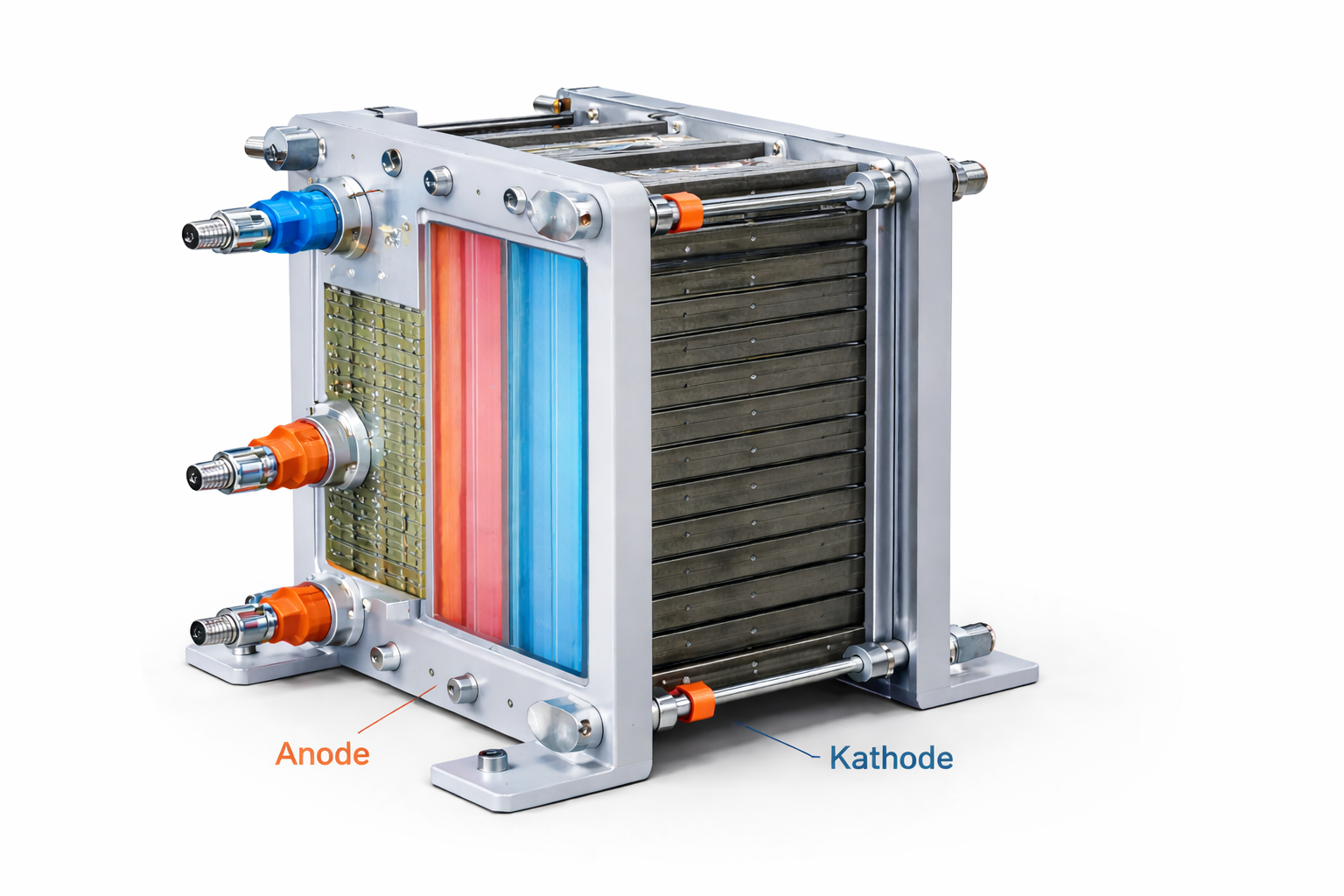
Key Components in the Structure of a Fuel Cell
Anode: The Start of the Reaction
The anode acts as the negative electrode of the fuel cell and is where fuel oxidation takes place. In hydrogen fuel cells, the H₂ molecule is split by a catalyst, typically platinum, into protons and electrons. The reaction is: 2H₂ → 4H⁺ + 4e⁻.
The anode design requires a porous structure that distributes the fuel evenly while optimizing mass transport. Gas diffusion layers ensure uniform gas distribution and help ensure that the catalyst is used to its full potential. The choice of anode material directly affects the reaction rate and therefore the overall cell performance.
Cathode: Completing the Reaction
At the cathode, the positive electrode of the fuel cell, the reduction reaction takes place. Here, the protons coming from the anode meet oxygen from the air and the electrons that have flowed through the external circuit. The reaction is: O₂ + 4H⁺ + 4e⁻ → 2H₂O.
The cathode must be designed to provide efficient oxygen supply while also removing the water that is produced. A critical aspect is water management because too much water can block the gas channels, while too little water can dry out the membrane and reduce proton conductivity.
Electrolyte: The Core of Ion Conduction
The electrolyte separates the anode and cathode and allows only the transport of protons. In PEM fuel cells (Proton Exchange Membrane), the electrolyte consists of a special polymer membrane that is permeable only to protons while blocking electrons.
This selective permeability forces electrons to pass through the external circuit, thereby generating usable electrical current. The membrane must meet specific requirements including high proton conductivity, chemical stability, mechanical strength, and controlled water uptake for optimal operation.
Bipolar Plates: Structure and Current Collection
Bipolar plates form the mechanical backbone of the fuel cell and fulfill several critical functions. They collect the generated current, distribute the reactant gases evenly, and remove heat. In addition, they separate neighboring cells within a fuel cell stack.
The design of the gas channels in the bipolar plates has a major influence on cell performance. Optimal channel geometries ensure minimal pressure losses while maintaining uniform gas distribution. Modern development processes use CFD simulations to optimize flow guidance and to eliminate hotspots or dead zones.
How a Fuel Cell Works: The Electrochemical Process
The operation of a fuel cell is based on controlled electrochemical reactions that can be divided into three simultaneous processes: fuel oxidation at the anode, oxygen reduction at the cathode, and proton transport through the electrolyte.
When hydrogen gas is fed to the anode, it contacts the catalyst and is split into protons and electrons. The protons migrate through the membrane to the cathode, while the electrons are forced to travel through the external circuit. At the cathode, protons, electrons, and oxygen combine to form water.
The overall reaction is: 2H₂ + O₂ → 2H₂O + electrical energy + heat. This reaction is exothermic, which is why effective thermal management is crucial for the service life and performance of the cell.
How a Fuel Cell Operates: System Integration and Operating Parameters
Operating a fuel cell requires precise coordination of various subsystems. The fuel supply system must ensure a constant hydrogen flow, while the air supply system provides sufficient oxygen. At the same time, humidity, temperature, and pressure must be kept within optimal ranges.
Power control is achieved by adjusting the reactant flow rates to match electrical demand. At higher current demand, more hydrogen and air are supplied, which increases the reaction rate. Modern fuel cell systems use sophisticated control algorithms that continuously monitor and adjust all operating parameters.
A critical aspect is water management. The membrane must be sufficiently humidified to ensure high proton conductivity, but water accumulation in the gas channels must be avoided. This requires a balanced design of the gas channels and operating conditions.
Fuel Cell Types and Their Industrial Applications
PEM Fuel Cells for Mobile Applications
Proton Exchange Membrane fuel cells operate at low temperatures of 60 to 100°C and are particularly suitable for mobile applications such as vehicles or portable devices. Their fast response and compact design make them the preferred choice for electric vehicles and material handling systems.
High Temperature Fuel Cells for Industrial Processes
Solid Oxide Fuel Cells (SOFC) and Molten Carbonate Fuel Cells (MCFC) operate at temperatures of 600 to 1000°C and are suitable for stationary applications with high heat demand. The waste heat produced can be used for combined heat and power, which significantly increases overall efficiency.
Design Challenges and Development Approaches
Developing efficient fuel cells requires the consideration of multiple optimization objectives including maximum efficiency, long service life, low costs, and compact design. These requirements lead to complex design challenges that demand modern development methods.
CFD simulations play a central role in optimizing gas distribution and thermal management. Detailed flow analyses can minimize pressure losses while ensuring uniform distribution of reactants. The integration of machine learning algorithms enables automated optimization of complex geometries.
Material selection and surface treatments influence both performance and cost. Innovative catalyst materials can reduce the required amount of platinum, while new membrane materials can enable higher operating temperatures and longer service life.
Quality Assurance and Service Life Optimization
The durability of fuel cells depends on various degradation mechanisms. Catalyst poisoning, membrane embrittlement, and corrosion of bipolar plates are the main factors that limit service life. Systematic quality assurance begins in the development phase with the selection of suitable materials and design principles.
Accelerated aging tests enable the assessment of long term stability without years of testing cycles. By applying controlled stress factors such as temperature cycling, humidity fluctuations, and load changes, potential weak points can be identified and eliminated.
Scaling and Industrialization
The transition from prototypes to series production requires manufacturing aspects to be considered early in the development phase. Design for Manufacturing principles help ensure that complex geometries are suitable for production while also optimizing performance.
Automated manufacturing processes for MEA production (Membrane Electrode Assembly) and stack assembly are crucial for cost reduction. The implementation of quality control systems ensures consistent product quality even at high volumes.
Digital Development Tools for Fuel Cells
Modern fuel cell development uses digital twin technologies that complement physical prototypes with highly accurate simulation models. These models enable prediction of system behavior under different operating conditions and significantly accelerate the development process.
AI driven design optimization can evaluate millions of design variants and automatically identify optimal configurations. Machine learning algorithms learn from experimental data and simulation results to make better predictions and minimize development risks.
The integration of simulation data with real test data enables continuous improvement of the models and creates a solid foundation for innovation. These data driven approaches shorten development cycles while also reducing development costs.

Conclusion: Fuel Cells as a Driver of Industrial Innovation
The systematic structure of a fuel cell requires precise coordination of all components and their optimization for specific application requirements. From the molecular level of catalytic reactions to system integration, all aspects must be considered to develop solutions that are both economical and high performing.
Modern development methods combine proven engineering principles with innovative digital tools and enable the realization of highly efficient fuel cell systems. The integration of AI, and data driven optimization methods not only accelerates development but also improves product quality.
For companies that want to integrate fuel cell technology into their products, sound technical consulting and systematic development support are essential. Contact Felsaris for comprehensive guidance on your fuel cell project and benefit from our expertise in developing innovative energy systems.
Frequently Asked Questions About Fuel Cell Structure
Which factors determine the performance of a fuel cell?
The performance of a fuel cell is determined by several key factors including catalyst activity and distribution, membrane conductivity, efficiency of gas distribution, water management, and operating temperature. An optimal balance of all parameters is essential for maximum efficiency.
How long do modern fuel cells last?
The service life of modern fuel cells varies depending on the application and quality. Automotive fuel cell systems now reach 5,000 to 8,000 operating hours, while stationary systems can reach up to 40,000 hours or more. Regular maintenance and optimal operating conditions significantly extend service life.
What maintenance do fuel cell systems require?
Fuel cell systems require regular checks of gas purity, monitoring of membrane humidity, cleaning of air filters, and inspection of electrical connections. Preventive maintenance prevents performance losses and extends system life. Modern systems continuously monitor critical parameters.
Can fuel cells be combined with other renewable energy sources?
Yes, fuel cells can be combined very effectively with other renewable energy technologies. Hydrogen can be produced by electrolysis using solar or wind energy, creating a fully sustainable energy cycle. These hybrid solutions offer high flexibility and security of supply.
How is the safety of fuel cell systems ensured?
Fuel cell systems include multiple layers of safety. Hydrogen sensors detect leaks early, automatic shut off valves stop the gas supply in case of issues, and pressure relief valves prevent damage from overpressure. Modern systems continuously monitor all safety relevant parameters and respond immediately to anomalies.