.svg)
.svg)

Industrial 3D Printing: Applications, Technologies, Benefits
Industrial 3D printing explained clearly. Learn about applications, technologies, selection criteria, and profitability, with practical guidance for fast implementation.
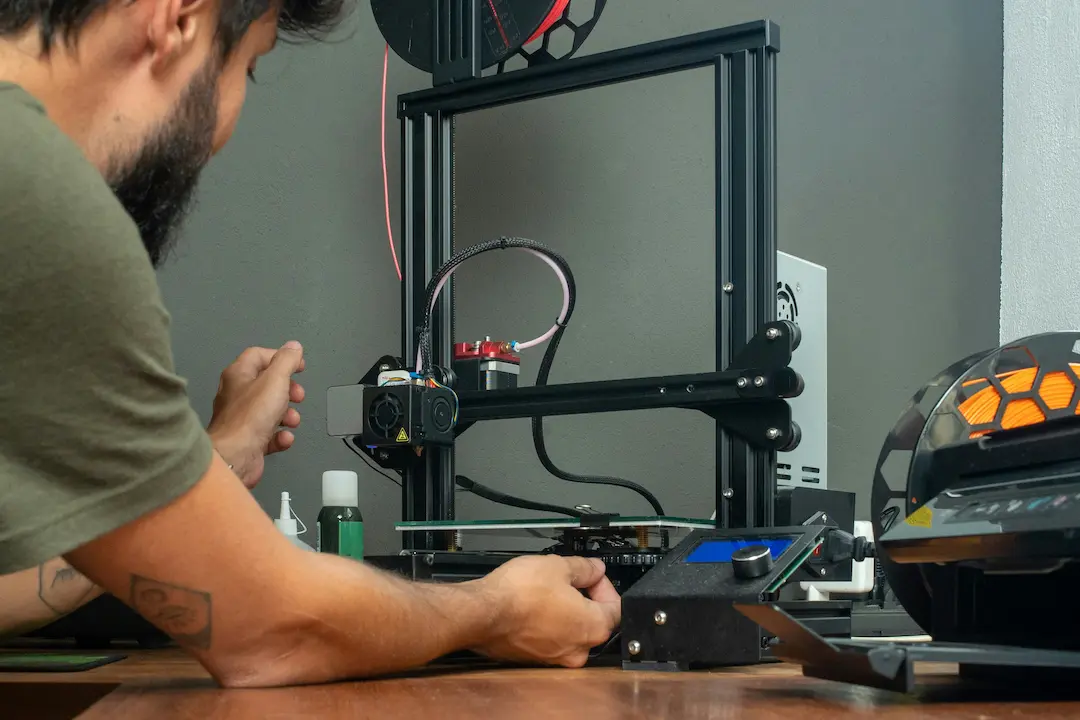
Industrial 3D Printing: A Revolutionary Manufacturing Technology
Industrial 3D printing has evolved from an experimental technology into an indispensable production tool. Industrial additive manufacturing enables companies to produce complex geometries without tooling, reduce material consumption, and drastically shorten development times. For small and medium-sized enterprises, 3D printing offers the opportunity to realize innovative products without high investments in tools and molds.
Additive manufacturing is revolutionizing prototyping, small-batch production, and spare parts manufacturing in particular. While conventional manufacturing processes quickly reach their limits with complex components or cause high costs, industrial 3D printing enables economical production even at low quantities.
Applications in Industrial Production
The applications of 3D printing in industry are diverse and continue to grow steadily. Prototyping remains the primary focus: over 60 percent of companies use additive manufacturing mainly in research and development. Thanks to rapid iteration, design variants can be validated within a few days instead of weeks.
Toolmaking and manufacturing aids have established themselves as the second key application area. Companies produce fixtures, clamping devices, and assembly aids directly on site. This not only reduces costs, but also significantly shortens lead times. Additive methods show clear advantages, especially for custom tools or small quantities.
Spare parts production is becoming increasingly important. Instead of building up expensive inventory, companies can produce spare parts on demand. This is particularly relevant for older machines whose original parts are no longer available. With 3D scanning and reverse engineering, even complex components can be reproduced without original CAD data.
In aerospace as well as the automotive industry, near-series components are already being created through additive manufacturing. Lightweight structures with complex internal geometries that could not be produced conventionally offer significant weight savings and functional improvements.
Industrial 3D Printers: Comparing Technologies
When selecting suitable industrial 3D printers, several factors play a decisive role. The choice of technology depends on specific requirements such as materials, accuracy, surface quality, and production volume.
FDM technology (Fused Deposition Modeling) is particularly suitable for prototypes and functional parts made from thermoplastic materials. Industrial FDM printers process high-performance polymers such as PEEK or PEI and achieve sufficient mechanical properties for many applications. The technology is comparatively cost-effective and easy to handle.
SLA and DLP processes (Stereolithography and Digital Light Processing) provide the highest surface quality and fine detail resolution. Resin-based systems are particularly suitable for fine structures, complex geometries, and applications where surface quality is critical. Modern industrial resins achieve mechanical properties that come close to those of conventional plastics.
Powder bed processes such as Selective Laser Sintering (SLS) or Multi Jet Fusion (MJF) enable the production of functional parts without support structures. The technology is particularly suitable for end-use parts and small series. In addition to plastics, metals can also be processed, which opens up entirely new design possibilities.
Metal 3D printing using laser powder bed fusion or electron beam melting is increasingly gaining ground in industrial applications. Titanium alloys, aluminum alloys, and stainless steels can be processed into high-strength components. Especially in aerospace, this allows the production of components that would not be feasible with conventional methods.
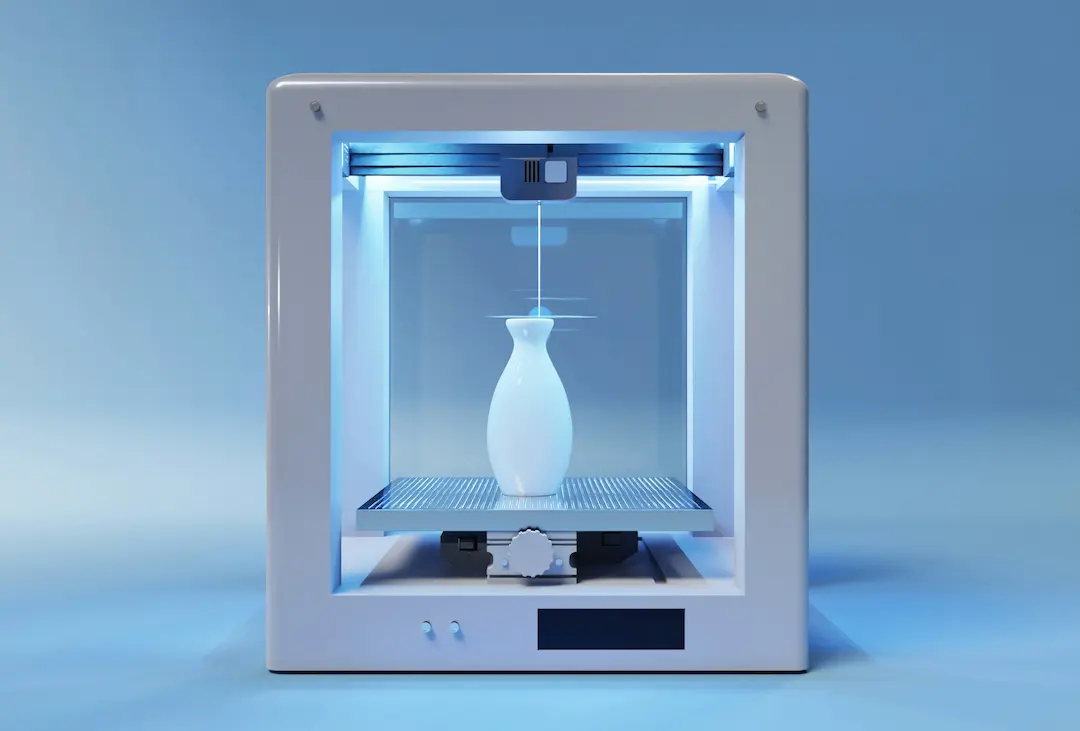
Advantages of Industrial 3D Printing
Design freedom is the greatest advantage of additive manufacturing. Complex internal structures, undercuts, and function-integrated designs can be realized without additional cost. Topology-optimized components reduce weight while improving performance at the same time. These possibilities enable entirely new design approaches.
Reduced time to market significantly accelerates innovation cycles. Prototypes can be produced within a few days directly from CAD data. Changes can be implemented immediately without having to modify tools. For startups and innovative companies, this represents a decisive competitive advantage.
Cost efficiency at low volumes makes 3D printing particularly attractive for specialized parts and customized solutions. While conventional manufacturing involves high fixed costs for tools, unit costs in additive manufacturing remain nearly constant. This enables economical production even for a batch size of one.
Material savings and sustainability support the case for additive methods. Material is applied only where it is needed, which results in virtually no waste. At the same time, lighter structures enable energy savings during use, for example in vehicles or aircraft.
Local production reduces transport distances and inventory levels. Companies can produce on site when needed instead of relying on global supply chains. This increases flexibility while also reducing environmental impact.
Limitations and Challenges
Despite all its advantages, industrial 3D printing also has limitations that must be considered when choosing a technology. Production speed remains a critical factor. For large volumes, conventional manufacturing methods are still superior. Build time increases significantly with the complexity and size of the parts.
Material variety has grown, but it still does not match the breadth of conventional manufacturing. Limitations may arise, especially for specialized property requirements or certifications. Material costs are often significantly higher than those of conventional materials.
Surface quality and dimensional accuracy vary greatly depending on the process and application. Post-processing steps are often required, which adds additional cost. For tight tolerances, conventional finishing steps are frequently unavoidable.
Quality assurance imposes special requirements. Process stability, material quality, and reproducibility must be monitored continuously. Non-destructive testing methods for additively manufactured parts are often more complex than for conventionally produced parts.
3D Printer Testing: Selection Criteria for Industry
A systematic 3D printer test should consider several aspects in order to identify the optimal technology for specific requirements. Material compatibility is the top priority. Industrial applications often require specific material properties such as temperature resistance, chemical resistance, or mechanical strength.
Build volume and accuracy must match the intended applications. While jewelry manufacturing demands the highest level of detail, mechanical engineering applications often prioritize strength and functionality. A balanced relationship between build volume and achievable accuracy is crucial.
Operating costs include more than just the purchase price. Material costs, maintenance effort, energy consumption, and required post-processing strongly influence overall profitability. A total cost of ownership assessment is essential.
Software integration into existing CAD and CAM workflows greatly facilitates adoption. Seamless data transfer and automated process preparation reduce sources of error and processing time.
Service and support from the manufacturer determine long-term availability and productivity. Training, technical support, and spare parts supply are critical factors for industrial use.
3D Printing Ideas for Industrial Applications
Innovative 3D printing ideas often emerge at the intersection of different disciplines. Functional integration enables the combination of multiple parts in a single print. For example, bearings, joints, or spring mechanisms can be printed directly, which reduces assembly effort and tolerance chain complexity.
Biomimetic designs transfer structures from nature into technical applications. Honeycomb structures, branching patterns, or optimized load paths are created using generative design algorithms and topology optimization. These approaches lead to significant weight reductions along with improved performance.
Embedded functions such as cooling channels, sensors, or electrical conductors can be integrated directly into components. Conformal cooling in injection molding tools or integrated temperature sensors in mechanical components are already established applications.
Modularity and adaptability enable customer-specific solutions without dedicated tooling. Base structures remain unchanged, while specific functions are implemented through interchangeable modules. This combines the benefits of standardization and customization.
Repair and retrofit of existing equipment using 3D-printed components extend machine service life and reduce downtime. Adaptation parts for new requirements or improvements can be implemented quickly and cost-effectively.
Future Technologies and Trends
Hybrid manufacturing combines additive and subtractive processes in one machine. After 3D printing, critical surfaces are automatically finished by machining. This unites design freedom with precision and opens up new fields of application.
AI-driven process optimization continuously improves quality and efficiency. Machine learning algorithms analyze process data in real time and automatically adjust parameters. Predictive maintenance reduces unplanned downtime and scrap.
Multi-material printing enables the production of parts with different material properties in a single print. Hard and soft areas, conductive and insulating zones, or different colors can be placed precisely.
Large-format 3D printing is opening up new application areas. Components for architecture, automotive body parts, or aerospace structures are printed directly. This reduces assembly effort and enables entirely new design approaches.
Profitability Assessment for SMEs
For small and medium-sized enterprises, a sound profitability analysis is essential. Break-even quantities vary greatly depending on part complexity and the chosen technology. While simple components often become economical only at higher volumes, complex geometries can be more cost-effective than conventional manufacturing even at a batch size of one.
Strategic advantages such as shorter development times or faster innovation are difficult to quantify monetarily, but they provide decisive competitive benefits. Time-to-market reductions of 30 to 50 percent are possible in many industries.
Risk reduction through early functional validation minimizes development costs. Design errors are identified before expensive tooling is created. This is especially important for innovative products with high risk.
Flexibility in production enables quick responses to market changes. Product adaptations or new variants can be implemented without investing in new tools.
Quality Assurance and Certification
Quality standards for additive manufacturing are continuously evolving. ISO and ASTM standards define processes, materials, and testing methods. Additional certifications are required for safety-critical applications.
Process monitoring through integrated sensors enables real-time quality control. Temperature distribution, layer adhesion, and dimensional accuracy can be monitored continuously. This reduces scrap and improves process stability.
Documentation and traceability are particularly necessary in regulated industries such as medical technology or aerospace. Complete process documentation from material batch to post-processing ensures quality and compliance.
Integration into Existing Production Processes
Workflow integration often requires adjustments to existing processes. CAD systems must be optimized for additive manufacturing, design guidelines must be adapted, and employees must be trained. Change management is crucial for successful implementation.
Hybrid strategies combine additive and conventional manufacturing in an optimal way. Complex structures are created through 3D printing, while critical surfaces are finished conventionally. This maximizes the advantages of both methods.
Supply chain integration significantly expands possibilities. Instead of keeping all technologies in house, specialized service providers can be used flexibly. This reduces investment and risk while maintaining the broadest possible technology access.
Conclusion
3D printing in industry has evolved from a prototyping technology into a fully fledged production method. This opens up entirely new opportunities, especially for small and medium-sized enterprises. Complex components can be realized without high tooling costs, development times are dramatically reduced, and innovative designs can be implemented economically.
Selecting the right technology and integrating it into existing processes requires sound know-how and experience. CAD design, simulation, and additive manufacturing, optimized solutions are created that meet both technical and economic requirements.
Felsaris supports companies in evaluating 3D printing potential, selecting the right technology, and implementing specific projects. By combining CAD design, simulation, and additive manufacturing, optimized solutions are created that meet both technical and economic requirements.
Contact Felsaris for an individual consultation on your 3D printing projects and discover how additive manufacturing can revolutionize your product development.
Frequently Asked Questions
Which materials are suitable for industrial 3D printing?
Industrial 3D printers process a wide range of materials, from standard plastics such as PLA and ABS to high-performance polymers such as PEEK and PEI, as well as metals such as titanium, aluminum, and stainless steel. Modern SLA and DLP resins achieve mechanical properties comparable to conventional plastics. The material choice depends on specific requirements such as temperature resistance, mechanical strength, or chemical resistance.
How cost-effective is 3D printing compared to conventional manufacturing?
Cost effectiveness depends strongly on quantity, complexity, and material properties. For low volumes and complex geometries, 3D printing is often superior because there are no tooling costs. Break-even quantities range from one part to several hundred parts. Strategic advantages such as shorter development times and increased design freedom must also be considered.
Which quality standards apply to additive manufacturing?
ISO and ASTM standards such as ISO/ASTM 52900 define terminology and the classification of additive manufacturing processes. For safety-critical applications, industry-specific standards exist, such as AS9100 for aerospace or ISO 13485 for medical technology. Qualification of processes, materials, and parts is carried out according to defined test protocols.
Can existing CAD data be used for 3D printing?
In principle yes, but CAD data often must be optimized for additive manufacturing. Wall thicknesses, support structures, and surface orientation have a major influence on printability and quality. Design for additive manufacturing guidelines help to use the advantages of 3D printing effectively. Reverse engineering through 3D scanning enables the digitization of existing components.
What post-processing is required after 3D printing?
The required post-processing varies depending on the process and application. FDM parts usually only require support removal, while SLA parts must be cleaned and post-cured. Mechanical finishing such as sanding, drilling, or tapping threads is often necessary for function-critical surfaces. Surface treatments such as painting or coating are possible depending on the application.