.svg)
.svg)

CFD Simulation: Mastering Flow and Cooling Optimization
CFD simulation makes flow and heat visible: Validate designs early, reduce pressure losses, optimize cooling, and accelerate development.
.jpg)
CFD Simulation for Efficient Optimization of Flow and Cooling
Due to shortened development cycles in global competition, modern product development today faces the challenge, among others, of optimizing complex flow and thermal processes quickly and cost-effectively. A CFD simulation (Computational Fluid Dynamics) offers the ideal solution for this: It makes invisible flows, temperature fields, and aerodynamic effects virtually visible and enables precise design validation even before the first prototype. This numerical calculation method computationally solves the complex Navier-Stokes equations and provides detailed insights into flow behavior, pressure losses, heat transfer, and cooling performance.
Fundamentals of CFD Simulation: From Theory to Practical Application
A CFD simulation is based on the physical laws of fluid mechanics and uses numerical methods to mathematically describe fluid movements. The process begins with the discretization of the flow domain into a computational grid (mesh), whereby the geometry is divided into millions of small cells. In each cell, the conservation equations for mass, momentum, and energy are then solved.
The challenge lies in the correct modeling of complex phenomena such as turbulence, heat transfer, combustion, or multiphase flows. Modern approaches such as RANS (Reynolds-Averaged Navier-Stokes), LES (Large Eddy Simulation), or DNS (Direct Numerical Simulation) offer different levels of accuracy depending on requirements and available computing power. RANS is the industry standard due to the compromise between computing power and result quality, while LES is only suitable for special applications in which the discrete resolution of larger eddies is necessary.
Particularly in cooling optimization, the coupled simulation of flow and heat transfer plays a central role. Here, not only the pressure and velocity fields, but also temperature distributions, heat flux densities, and convective heat transfer coefficients are calculated. This enables precise prediction of hot spots, evaluation of cooling concepts, and optimization of heat exchangers.
The Three-Stage CFD Workflow: From Geometry to Results
Pre-Processing: The Foundation for Reliable Results
The first step of a CFD simulation includes defining the problem and selecting an appropriate computational model. CAD geometries are prepared for simulation, whereby simplifications are often necessary to limit computing time. Mesh generation is critical for result quality: Meshes that are too coarse lead to less accurate results, while meshes that are too fine increase computing time exponentially.
Boundary conditions such as inlet velocities, temperatures, wall properties, and pressure ratios must be physically correctly defined. The choice of turbulence models, material data, and solver settings significantly determines the prediction quality and runtime of the simulation.
Calculation/Solving: High-Performance Computing for Complex Flows
The actual calculation is performed iteratively by numerical solvers that solve the discretized equations at each grid point. Modern CFD software parallelizes these calculations on high-performance computers (HPC - High Performance Computing), making even complex, transient simulations with millions of cells feasible in acceptable time.
Steady-state simulations consider time-averaged states, while transient approaches capture time-dependent phenomena such as pulsations, start-up processes, or periodic flows. The convergence of the solution is monitored by the residuals of the conservation equations or custom parameters, such as mass flow through a surface. A simulation is considered converged ("settled") when it remains below the set convergence criteria for a certain number of iterations and thus meets them.
Post-Processing: Insights for Engineering Decisions
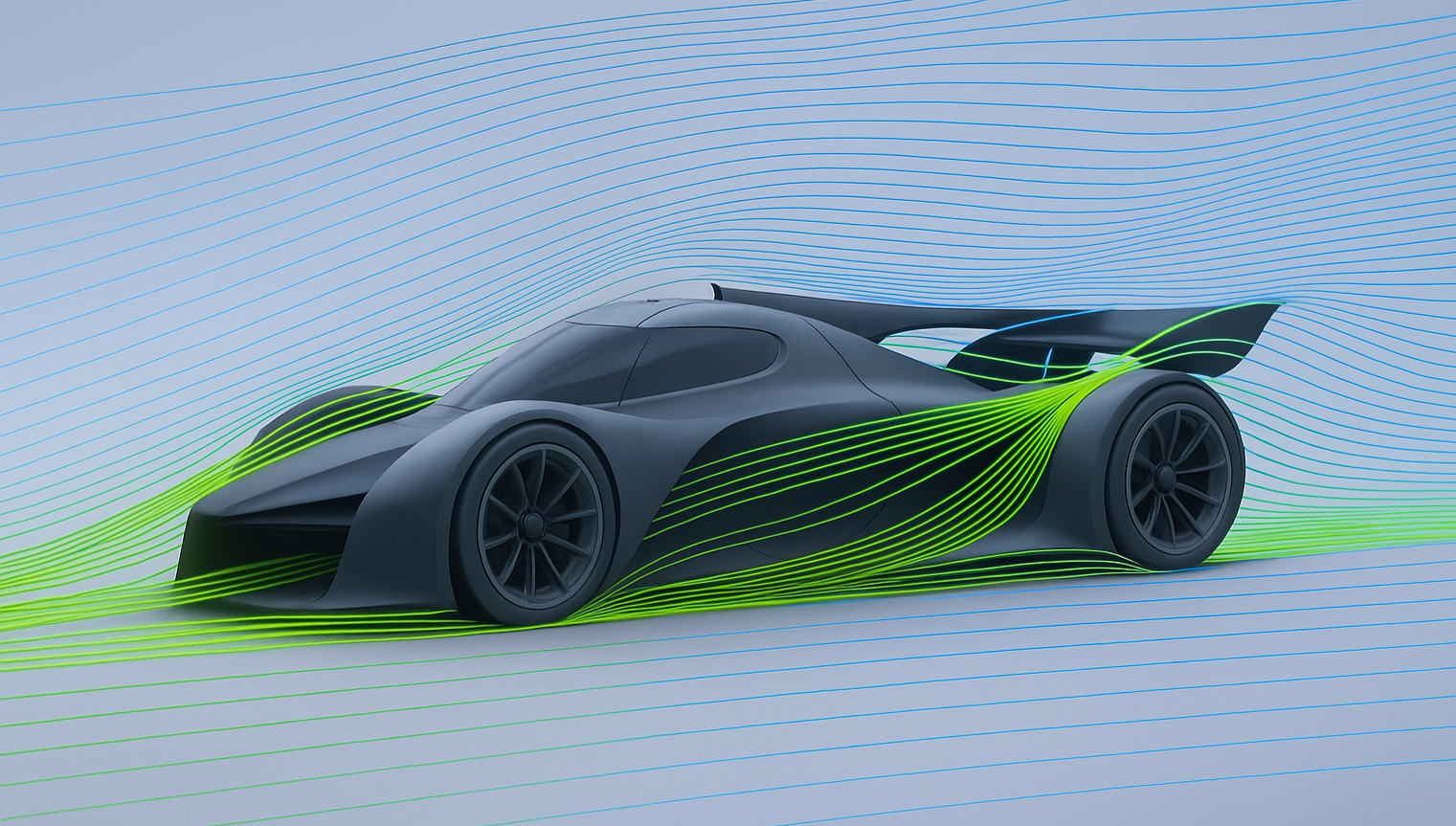
The evaluation of simulation results converts numerical data into engineering-ready information. Streamlines visualize velocity fields, contour plots show temperature or pressure distributions, and vector representations make vortices and recirculation zones visible. Since 3D CFD simulations are predestined to present flow data in a visually appealing way, the results are first evaluated qualitatively. This helps the developer understand the flow behavior for the specific application and get a feel for it.
In the next step, quantitative evaluations deliver integrated quantities such as pressure losses, heat transfers, mass flows, or acting forces. These quantitative parameter evaluations enable direct comparisons of different design variants and form the basis for well-founded optimization decisions.
Application Areas: Where CFD Simulations Bring Decisive Advantages
Flow Optimization in Technical Systems
CFD simulations show their strengths in optimizing both internal and external flows. In internal flows, such as pipelines, valves, pumps, or compressors, flow separations, recirculation zones, and pressure losses can be precisely located and minimized through geometric adjustments. This leads to higher efficiencies, lower energy consumption, and reduced noise generation.
For external flows, such as around vehicles, drones, or housing structures, CFD analysis enables targeted reduction of aerodynamic drag as well as optimization of cooling and ventilation concepts. Through virtual variant comparisons, design decisions can be validated early in the development process and physical prototypes reduced, which significantly lowers development time and costs.
Cooling Optimization for Electronics and Mechanical Engineering
Thermal simulation is a core area of modern CFD simulation. Electronic components, battery systems, electric motors, or power semiconductors generate heat losses that must be efficiently dissipated. CFD enables detailed analysis of heat flow paths, identification of hot spots, and evaluation of different cooling concepts.
Air-cooled systems are optimized with regard to fan positioning, air guidance, and fin geometry. Liquid cooling requires analysis of coolant flows, heat exchanger performance, and pressure losses in the cooling circuit. The demanding but valuable simulation of cavitation is also important here to prevent hot spots and wear. Passive cooling concepts use natural convection and heat conduction, which is particularly relevant in silent or maintenance-free systems.
Aerodynamic Development for Vehicles and Machines
External flows around vehicles, aircraft, drones, or wind turbines significantly determine their performance and energy efficiency. CFD simulation enables detailed analysis of air resistance, lift, side forces, and aerodynamic moments already in early development phases.
Vehicle aerodynamics aims at minimal air resistance for low fuel consumption, while simultaneously ensuring driving stability and cooling air supply. In the sports car or motorsport segment, downforce is also relevant for increasing traction during cornering at high speeds. For aircraft, lift-to-drag ratio, stall behavior, and control surface effectiveness are the focus.
CFD Simulation Software: Tools for Professional Flow Analysis
Commercial High-End Solutions
Professional CFD simulation software, both as stand-alone software such as Ansys Fluent, Siemens Simcenter STAR-CCM+, Convergent Science, or CAD-integrated CFD add-ons such as Simcenter FloEFD, offer comprehensive functionalities for complex flow problems. These programs master turbulent flows, multiphase physics, chemical reactions, and coupled multiphysics simulations.
Ansys Fluent is considered the industry standard for general CFD applications and offers robust solvers for steady-state and transient problems. The software supports parallel computing and enables automation of recurring tasks through macros and scripting.
Siemens Simcenter STAR-CCM+ is also widely used and is characterized by its integrated geometry processing, automatic mesh generation, and advanced turbulence models. The software shows its strengths particularly with moving geometries and fluid-structure coupling.
Open-Source Alternatives for Specialized Applications
OpenFOAM (Open Field Operation and Manipulation) is a freely available CFD toolbox that impresses with its flexibility and extensibility. The modular structure enables the development of customized solvers for special applications, but requires deeper knowledge of CFD theory and Linux systems.
SU2 is an open-source project specialized in optimization and multiphysics simulations. It is particularly suitable for aerodynamic shape optimization and adjoint-based design studies.
Cloud-Based and User-Friendly Solutions
SimScale, a German company, offers browser-based CFD simulation in the cloud and makes powerful calculations accessible without local hardware investments. The intuitive user interface facilitates entry, while the cloud infrastructure scales automatically.
Simcenter FloEFD integrates seamlessly into CAD workflows and offers guided simulation processes for typical use cases. This reduces training time and minimizes application errors, while simultaneously compressing the entire development process through the fusion of CAD and CFD domains.
CFD Simulation Program Selection: Criteria for the Right Decision
Defining Application-Specific Requirements
The choice of the appropriate CFD simulation program depends primarily on the flow engineering problems to be solved. Simple internal flows with heat transfer require different capabilities than complex multiphase flows with chemical reactions or moving geometries.
Laminar flows up to Reynolds numbers of about 2300 can be calculated with simpler models and coarser meshes. Turbulent flows require specialized turbulence models such as k-ε, k-ω, SST, or Reynolds stress models, which increases the requirements for software and computing power.
Integration into Existing Development Processes
Modern product development is characterized by CAD integration and workflow automation. CFD software should communicate seamlessly with common CAD systems such as SolidWorks, Solid Edge, or Creo and support parametric geometry changes.
Automation of recurring tasks through macros, batch processing, or API interfaces reduces processing times and minimizes human errors. Design of Experiments (DoE) and optimization algorithms enable systematic parameter studies and automatic design improvement.
Licensing Models and Total Cost of Ownership
Commercial CFD software causes significant licensing costs that must be considered in budget planning. Node-locked licenses are cost-effective for individual workstations, while floating licenses offer flexibility for teams. High-performance computing often requires additional HPC licenses.
Cloud-based solutions offer pay-per-use models that are particularly attractive for sporadic CFD use. Total cost consideration must include not only license fees but also hardware investments, maintenance, training, and support. The costs for a simulation engineer with corresponding CFD annual license and workstation or HPC computing hours can quickly reach €200,000 per year. Many companies therefore resort to external engineering firms that specialize in CFD simulation.
Validation and Accuracy: Building Trust in CFD Results
Mesh Convergence and Numerical Accuracy
The quality of the computational mesh significantly determines the accuracy of the CFD simulation. Mesh convergence studies systematically investigate the influence of mesh fineness on the results. Successive mesh refinements are performed until the relevant quantities no longer change significantly.
Near-wall flows require particularly fine meshes, whereby dimensionless wall distances y+ of less than 1 are necessary for accurate boundary layer resolution. Adaptive mesh refinement can automatically identify critical areas and adjust cell density accordingly.
Experimental Validation and Benchmarking
CFD results should be regularly validated against experimental data to build trust in prediction quality. Commonly used benchmark cases are the Taylor-Green vortex for checking numerical dissipation and turbulence modeling, the backward-facing step flow for analyzing flow separations and recirculation zones, and the cylinder flow for investigating unsteady vortex shedding and pressure distributions.
Experimental validation can be performed through Particle Image Velocimetry (PIV), Laser Doppler Anemometry (LDA), or pressure measurements. Especially for new application areas or unconventional geometries, experimental validation is indispensable. Even without validation, 3D CFD simulations are very valuable as they at least deliver qualitative results, i.e., tendencies that are extremely important for assessing parameter sensitivities. At the latest with experimental validation, CFD results can also deliver quantitative results and increasingly replace real prototypes.

AI-Assisted CFD: Accelerated Development Through Machine Learning
Surrogate Models for Real-Time Design Exploration
Artificial intelligence is revolutionizing CFD application through the use of surrogate models (substitute models). These use machine learning to approximate complex CFD relationships through quickly evaluable mathematical models.
Neural networks, Gaussian process regression, or support vector machines can predict flow behavior in seconds instead of hours after training with CFD data. This enables extensive parameter studies, real-time optimization, and design space exploration with thousands of variants.
For building your own surrogate models with machine learning that can drastically reduce your development times, please feel free to contact us.
Automated Geometry Optimization
Evolutionary algorithms, gradient methods, or particle swarm optimization can automatically find optimal geometries for flow engineering applications. The coupling of CFD simulation with optimization algorithms is achieved through parameterized CAD models and automated workflow orchestration.
Deep learning approaches can directly derive geometric improvement suggestions from flow fields and thus replace the traditional trial-and-error process with data-driven development. Generative design methods create completely new geometric forms that often surpass conventional design approaches.
Practical Implementation: From Idea to Validated CFD Solution
Project Planning and Requirements Definition
Successful CFD projects begin with clear objectives and realistic expectations. The physical phenomena to be investigated, required accuracies, and available resources must be defined. Typical project phases include feasibility study, model development, validation, and optimization.
Coordination between CFD specialists and designers is critical for practice-relevant results. Engineers must understand which design parameters influence the flow and how CFD insights can be translated into concrete design changes.
Quality Assurance and Documentation
Professional CFD projects require systematic quality assurance through documented workflows, plausibility checks, and review processes. Simulation models must be set up in a traceable manner and all assumptions transparently documented.
Best practices include version control of geometries and settings, automated convergence checks, and structured result documentation. This ensures reproducibility and facilitates collaboration in development teams.
Conclusion: CFD Simulation as Enabler for Innovative Flow and Cooling Optimization
CFD simulation has established itself as an indispensable tool for modern product development. It enables engineers to understand complex flow and heat transfer phenomena, identify design weaknesses early, and develop innovative solutions. The continuous advancement of software, hardware, and methods, particularly through AI integration, constantly expands application possibilities.
For companies looking to integrate flow engineering optimization into their product development, choosing the right CFD strategy is crucial. Felsaris supports you with flexible CFD on-demand solutions that offer immediate simulation capacity without long-term commitments. Schedule a consultation and discover how CFD simulation can accelerate your development processes and improve your products.
Frequently Asked Questions About CFD Simulation
What Does a Professional CFD Simulation Cost?
The costs for CFD simulations vary greatly depending on complexity and scope. Simple steady-state simulations start at around €2,000-5,000, while complex transient or multiphase simulations can cost €10,000-25,000 depending on the number of design iterations. On-demand services offer flexible solutions without high license investments, typically between €4,500-25,500 for 1-6 months project duration.
How Long Does a CFD Simulation Take?
The calculation duration depends on problem complexity, mesh size, and available computing power. Simple steady-state simulations can be calculated in hours, while complex transient analyses require days to weeks. Modern parallelization and cloud computing significantly reduce calculation times. As a practice-oriented rule of thumb, no regular CFD simulation should run longer than 48 hours. Otherwise, computing power should be increased or complexity reduced.
What Accuracy Do CFD Simulations Achieve?
With correct modeling and validation, CFD simulations achieve accuracies of 1-10% for technical applications. Turbulence models, mesh quality, and boundary conditions significantly influence precision. Experimental validation is indispensable for critical applications to build trust in the results.
Can CFD Completely Replace Experiments?
CFD simulations complement experiments but do not completely replace them. They significantly reduce the number of necessary prototypes and enable cost-effective parameter studies. However, final validation and acceptance measurements still require experiments, as real systems always contain effects that are simplified in simulation.
What Hardware Requirements Do CFD Simulations Have?
Modern CFD requires powerful hardware with multi-core processors (at least 8-16 cores), 32-128 GB RAM, and fast SSDs. Graphics cards accelerate certain calculations but are not mandatory. Cloud-based solutions eliminate hardware investments and offer arbitrarily scalable computing power.