.svg)
.svg)

How Does a Wind Turbine Work? Technology and Engineering
How does a wind turbine work? Learn about structure, energy conversion, pitch and yaw control, AI optimization, and grid integration in a concise overview.
Basic Principle of Energy Conversion in Wind Turbines
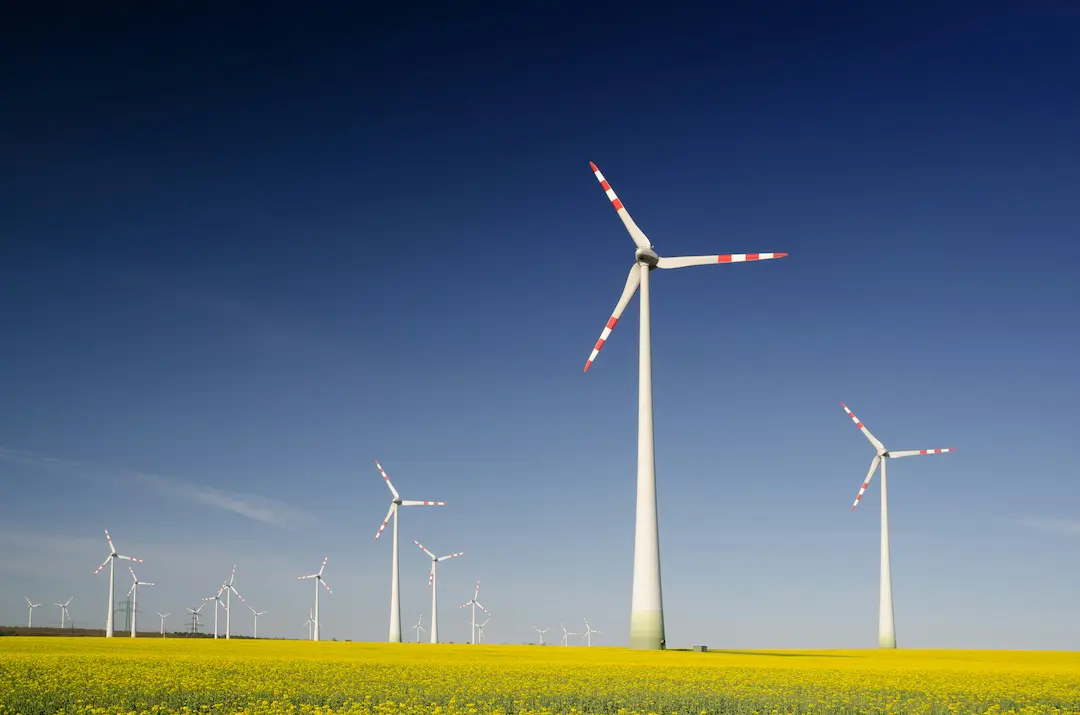
The operation of a wind turbine is based on several physical principles. Wind flows over the aerodynamically shaped rotor blades and creates lift due to different flow velocities on the upper and lower surfaces. This lift sets the rotor blades into rotational motion, similar to the principle of aircraft wings.
The kinetic wind energy is first converted into mechanical rotational energy. This rotational motion is transmitted via the main shaft to the gearbox, which increases the low rotor speed of about 15 to 40 revolutions per minute to the 1,000 to 1,500 revolutions per minute required by the generator.
In the generator, the final conversion of mechanical energy into electrical energy takes place. Magnets move past coils and generate alternating current through electromagnetic induction, which is then conditioned and fed into the power grid.
Structure of a Wind Turbine: Components and Design
Rotor and Rotor Blades
The core of every wind turbine is the rotor with its typically two to three rotor blades. These are made of high strength composite materials such as fiberglass or carbon fiber and, in modern turbines, reach lengths of 50 to 80 meters.
The aerodynamic shaping of the blades is crucial to the turbine’s efficiency. They are designed to generate optimal lift at different wind speeds. A sophisticated pitch control system allows the blade angle to be adjusted to adapt the turbine to changing wind conditions.
Nacelle and Machinery Housing
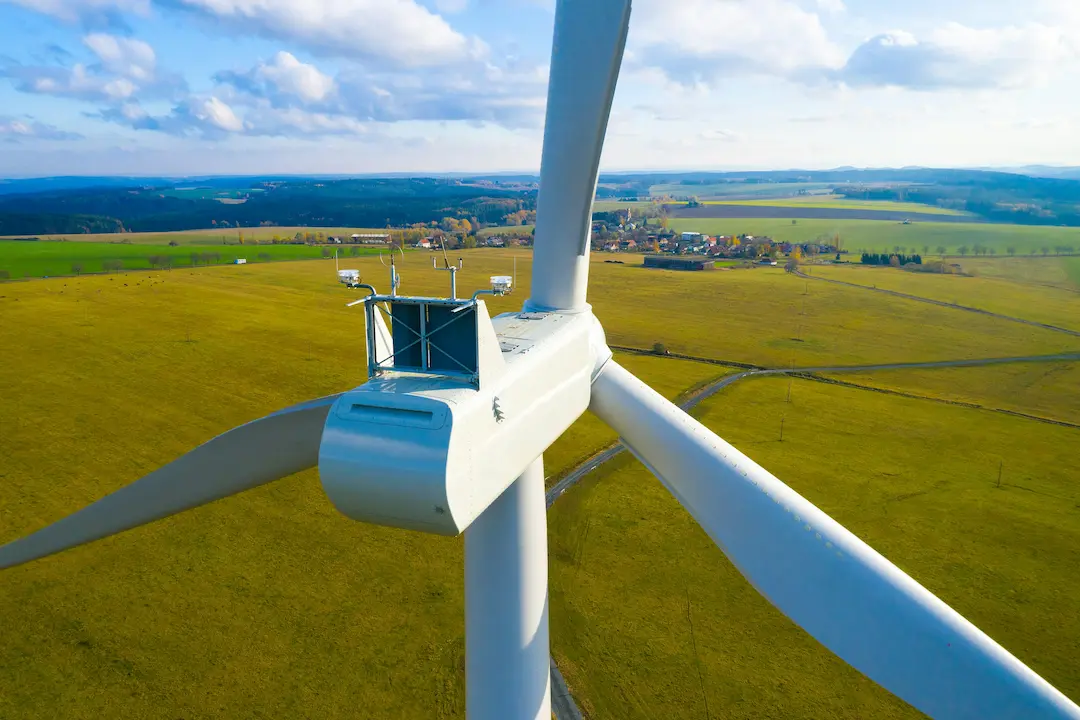
The nacelle houses all central components of energy conversion. It contains the generator, gearbox, main shaft, braking systems, transformer, and all control electronics. The machinery housing is designed to rotate 360 degrees so that the rotor can always be aligned optimally with the wind.
Modern turbines increasingly rely on gearless direct drive systems with low speed generators. These systems require less maintenance and have fewer mechanical losses, but they require heavier and more expensive generators.
Tower and Foundation
The tower carries the entire weight of the turbine and must withstand enormous wind loads. Modern towers reach heights of 100 to 150 meters and are usually made of individual steel segments or built as concrete towers. Tower height is critical because wind speeds and consistency increase significantly with height.
The foundation transfers all forces into the ground and usually consists of a massive reinforced concrete slab foundation with diameters of 15 to 20 meters.
Control Systems: Maximum Efficiency in All Wind Conditions
Modern wind turbines have highly advanced control systems that continuously adapt the turbine to wind conditions. The yaw system automatically aligns the nacelle to the optimal wind direction using wind direction sensors and GPS data.
Pitch control adjusts the rotor blades depending on wind speed. In light winds, the blades are positioned to capture maximum wind energy. In strong winds, they are turned out of the wind to prevent overload.
At wind speeds above 25 m/s, wind turbines shut down automatically. Aerodynamic brakes and mechanical disc brakes stop the rotor safely.
Innovative Technologies in Modern Wind Power Engineering
The development of wind turbines now increasingly relies on computer based optimization methods. CFD simulations (Computational Fluid Dynamics) enable precise analysis of flow behavior and aerodynamic properties already during the development phase.
Artificial intelligence and machine learning optimize the operation of existing turbines through predictive maintenance and intelligent power control. With these technologies, modern turbines can generate up to 10 percent more energy.
Offshore wind turbines place special technical demands on design and operation. They must be resistant to saltwater, withstand extreme weather conditions, and are often designed as floating platforms so they can be installed in deep waters.
Grid Integration and Power Conditioning
The alternating current generated by wind turbines passes through several conditioning stages. First, variable voltage and frequency are stabilized by power electronics. A transformer adjusts the voltage to meet grid requirements.
Modern turbines are designed to support the grid and can continue operating during voltage dips. They provide reactive power for voltage stabilization and can adjust active power output within seconds.
Smart grid management systems coordinate the feed in of many wind turbines and balance fluctuations. This enables a stable electricity supply even with high shares of wind energy in the grid.
How Many Wind Turbines Are There in Germany?
Germany has one of the largest wind power fleets in the world. By the end of 2023, around 29,000 wind turbines were installed in the country, with a combined capacity of about 70 gigawatts. These turbines already cover about 27 percent of Germany’s electricity demand.
Most German wind turbines are onshore: about 28,000 turbines with a total capacity of 60 gigawatts. Offshore, around 1,500 wind turbines are installed in the North Sea and Baltic Sea, reaching a capacity of 8 gigawatts due to better and more consistent wind conditions.
The federal government is planning a major expansion of wind energy. By 2030, installed onshore capacity is expected to rise to 115 gigawatts and offshore capacity to 30 gigawatts. This requires the construction of around 20,000 additional turbines in the coming years.
Regionally, wind energy is concentrated mainly in northern Germany. Lower Saxony leads with more than 6,000 turbines, followed by Brandenburg, Schleswig Holstein, and North Rhine Westphalia. In Bavaria and Baden Württemberg, wind power deployment is significantly lower due to restrictive setback regulations.
Operation and Maintenance: Service Life of 20 to 25 Years
Wind turbines are designed for an operating life of 20 to 25 years. During this time, they generate 40 to 50 times the energy required for their production. Regular maintenance is essential for high availability and long service life.
Modern condition monitoring systems continuously track all key parameters such as vibrations, temperatures, and oil conditions. Predictive maintenance uses this data to plan service work optimally and avoid unplanned downtime.
The decommissioning of old turbines, often referred to as repowering, makes it possible to replace older wind turbines with fewer but much more powerful new turbines. On the same area of land, it is often possible to generate three to five times more electricity.
Engineering Challenges in Wind Power Technology
The development of efficient wind turbines requires interdisciplinary engineering expertise. Fluid mechanics, materials science, electrical engineering, and control engineering must work together seamlessly.
A central challenge is reducing loads and vibrations. Wind turbines are exposed to extreme dynamic stresses: gusts, turbulence, rotor rotation, and tower resonance create complex stress distributions. Modern finite element analyses (FEA) and multi body simulations enable precise prediction of these loads.
Rotor blade aerodynamics are optimized through CFD simulations. Flow separation, tip vortices, and behavior at different angles of attack are analyzed. Machine learning algorithms help identify optimal blade geometries from millions of simulation data points.
The development of offshore wind turbines is particularly demanding. They must use saltwater resistant materials, withstand extreme storm loads, and rely on floating foundations. Specialized corrosion protection concepts and adaptive control algorithms are used for these applications.
Conclusion: Wind Turbines as a Key Technology of the Energy Transition
Wind turbines combine proven physical principles with state of the art engineering technology to create highly efficient energy conversion systems. Their operation is based on optimal use of aerodynamic forces, precise mechanical power transmission, and intelligent electronic control.
With nearly 30,000 installed turbines, Germany is a leader in wind energy deployment and is planning further major expansion. Modern development methods such as CFD simulation, AI based optimization, and condition monitoring continuously improve efficiency, reliability, and economic performance in wind power utilization.
Are you developing innovative energy technologies or planning to enter the wind power sector? Felsaris supports you with CFD simulations, flow optimization, and engineering consulting in the development of future oriented solutions. Schedule a consultation appointment now.
Frequently Asked Questions
How long does it take for a wind turbine to pay back the energy used for its production?
Modern wind turbines offset the energy required for manufacturing, transport, and installation after just 6 to 12 months. Over their service life of 20 to 25 years, they generate 40 to 50 times the energy originally invested.
How much electricity does a modern wind turbine generate per year?
A modern 3 MW onshore wind turbine generates about 6 to 8 million kWh per year under good site conditions. That corresponds to the electricity demand of about 2,000 to 2,500 households. Offshore turbines often achieve values that are about 50 percent higher due to better wind conditions.
Why do most wind turbines have three blades?
Three blades provide the best compromise between efficiency, stability, and cost. While two blade rotors are lighter, they produce stronger vibrations and a less stable visual impression. More than three blades would not significantly increase efficiency, but they would noticeably increase cost and weight.
How loud are wind turbines, and at what distance can they be approved?
Modern wind turbines produce sound levels of about 35 to 45 decibels at a distance of 500 meters, which is comparable to light rain. In Germany, minimum distances of 1,000 meters to residential areas apply. Through aerodynamic optimization and low noise operating modes, noise emissions have been significantly reduced in recent years.
Can wind turbines be damaged during storms?
Wind turbines are designed for extreme weather conditions and shut down automatically at wind speeds above 25 m/s. In a parked state, they can safely withstand gusts of up to 70 m/s. Modern turbines feature storm detection systems that initiate a safe shutdown in time and lock all moving parts.